

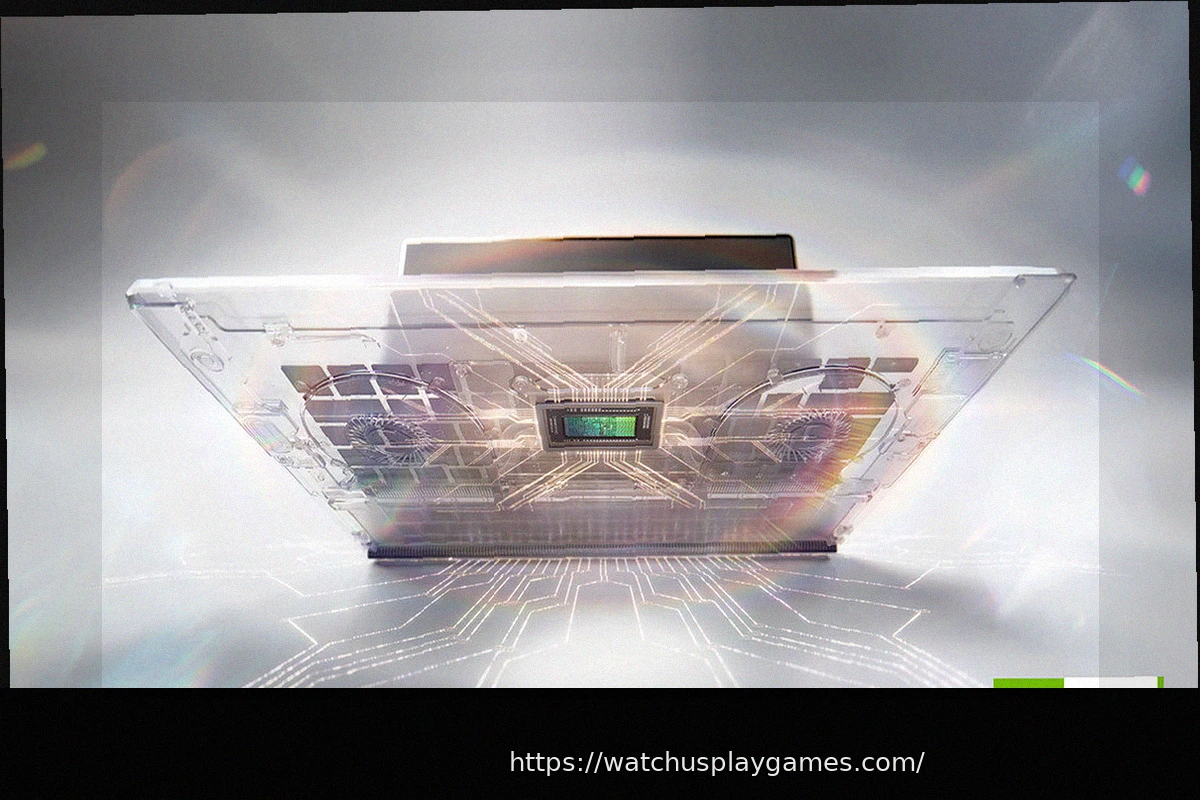
At Computex 2026, NVIDIA made a significant stride by introducing the RTX Spark, a novel Arm-based chip targeted at laptops and compact personal computers.
Computex has historically been a venue for major PC technology companies to unveil groundbreaking announcements that reshape personal computing. NVIDIA made a strong statement with the reveal of its new System-on-Chip (SoC). The RTX Spark offers the power equivalent to an RTX 5070, while enabling advanced AI capabilities, content creation, and gaming on an exceptionally mobile platform.
Developed in partnership with MediaTek, the RTX Spark is equipped with 6,144 CUDA cores, capable of one petaflop of FP4 AI performance, and features 20 Grace CPU cores. These can be coupled with up to 128 GB of unified LPDDR4X memory operating at 300 GB/s.
While there were speculations surrounding NVIDIA’s Computex announcements, the company provided detailed insights into the capabilities of its new SoC for laptops and mini-PCs, presenting an impressive outlook. Built on the Arm architecture, the RTX Spark is designed for a broad spectrum of applications. Its architecture enables tasks that are typically not feasible on laptops with such efficient operation.
NVIDIA highlighted during its presentation that the RTX Spark, by incorporating the complete NVIDIA software stack, can execute a variety of tasks, including running local AI agents. This allows for the operation of a 120 billion-parameter model with a 1 million-context window directly on the device, empowering users to leverage agents and AI workflows on their laptops without reliance on external services or subscriptions.
Beyond local AI processing, the RTX Spark is engineered for enhanced content creation and gaming. NVIDIA demonstrated its prowess in handling 12K 4:2:2 video editing, rendering 90 GB 3D scenes in software like Blender, and achieving over 100 FPS at 1440p in demanding titles such as DOOM, Cyberpunk 2077, and Indiana Jones and the Great Circle.
This announcement carries significant weight. NVIDIA is entering the mobile chip market, directly competing with Qualcomm, Intel, and AMD. With the advantage of NVIDIA RTX GPUs, laptops featuring RTX Spark are poised to overcome the typical compromises found in current Arm-based machines, particularly concerning graphics performance.
NVIDIA detailed the expected features of RTX Spark devices: all-day battery life, matte glass touchpads, precision-machined aluminum bodies as thin as 14 mm, HD cameras, and color-accurate tandem OLED G-Sync displays.
While Qualcomm has been making strides in GPU performance, the RTX Spark aims to deliver RTX 5070-level performance while maintaining Arm’s efficiency, presenting a compelling alternative.
Judging by the outlined consumer expectations for laptops, machines built with RTX Spark appear to be a highly anticipated, premium offering. NVIDIA elaborated on what users can anticipate from RTX Spark devices: extended battery life, matte glass touchpads, finely crafted aluminum chassis as thin as 14 mm, HD cameras, and high-fidelity, color-accurate tandem OLED G-Sync displays. These features collectively suggest a design optimized for content creation and gaming, delivering a top-tier laptop experience.
In conjunction with the RTX Spark announcement, NVIDIA detailed planned updates for Adobe Premiere and Photoshop designed to leverage the RTX Spark’s architecture. This will enable users to benefit from creative agents for various tasks within these applications, with NVIDIA promising up to double the speed for AI operations, editing, color grading, and effects.
“The finest creative work globally is produced using Adobe tools, from Adobe Firefly to Photoshop and Premiere, and the expansion of our partnership with NVIDIA and Microsoft will make these experiences faster and more potent than ever before,” stated Shantanu Narayen, Chair and CEO of Adobe. “Together, we are developing AI-native creative experiences for RTX Spark that deliver the performance, intelligence, and responsiveness individuals require to create at the pace of their ambition.”
Although AI was a focal point of the RTX Spark presentation, content creation also received considerable attention. NVIDIA elaborated on how the extensive features of RTX will be integrated into this new SoC, ensuring that all tools currently available to creators will be accessible on RTX Spark.
This includes the NVIDIA Blackwell video encoder, NVIDIA Broadcast and RTX Video technologies, DLSS and OptiX for 3D rendering, and AI capabilities that can be processed locally for diverse creative tasks. These functionalities can assist with streaming, aid in editing and creative projects, and offer a range of other applications based on user needs. With support across various software like OBS, CapCut, Blender, and Blackmagic Design, NVIDIA appears to have secured substantial industry backing to establish RTX Spark as a formidable presence upon its launch later this year.
“Blackmagic Design and NVIDIA have been instrumental in accelerating video production for many years,” commented Grant Petty, CEO of Blackmagic Design. “Portable, lightweight RTX Spark laptops with exceptional battery life will empower our customers to take the next significant step in on-the-go production.”
As an RTX-based platform, users can fully exploit NVIDIA’s gaming features. With specifications comparable to an RTX 5070, these thin-and-light laptops will offer ample power to run the latest games without compromising performance or visual fidelity.
NVIDIA provided a demonstration of the RTX Spark’s ability to deliver high frame rates in games such as Doom: The Dark Ages and Fortnite, enable modding through RTX Remix, and support ACE for in-game AI agents. However, it’s important to note that no comparative benchmarks were shared during the presentation, and performance-related inquiries were deferred to a later date this year. NVIDIA did confirm the upcoming inclusion of DLSS Ray Reconstruction for the RTX Spark upon its launch, further enhancing the transformer model in the latest DLSS version for visually impressive games at more playable frame rates.
Alongside the introduction of the new NVIDIA RTX Spark, NVIDIA also provided details on a new collaboration with Microsoft for an enhanced Windows experience focused on personal agents. This includes new security primitives and NVIDIA OpenShell for secure agent execution on the user’s primary device, offering greater flexibility for agentic workflows without requiring a separate machine.
The processing power of RTX Spark enables local agents to manage a wider array of tasks more effectively. As local models become increasingly sophisticated and capable of handling agentic workflows, the new features will empower laptops and mini-PCs equipped with RTX Spark to undertake more complex workloads, with AI actively assisting the user.
In a demonstration, NVIDIA showcased an agent assisting with a Photoshop workflow, offering novel approaches to tackle intricate tasks and overcome potential bottlenecks. The actual impact of these workflows on end results remains to be seen, but the concept of freeing up creatives by offloading repetitive or tedious tasks, allowing them to concentrate on their core strengths, is intriguing. The real-world application of these tools will be observed over time.
While comprehensive details regarding RTX Spark’s performance and the full feature set of laptops built on this new SoC are still forthcoming, the announced information is highly promising and is expected to significantly impact the laptop and compact mini-PC markets.
The overall design of the RTX Spark and its projected performance capabilities position NVIDIA as a major contender in mobile computing, adding another compelling option for those seeking a new gaming laptop. If the RTX Spark lives up to the generated hype, it could signify a substantial shift in the market later this year. Further details on this new SoC are anticipated, but current expectations suggest a high level of excitement for this new laptop SoC, with eager anticipation for its performance in gaming, content creation, and local AI workflows.