

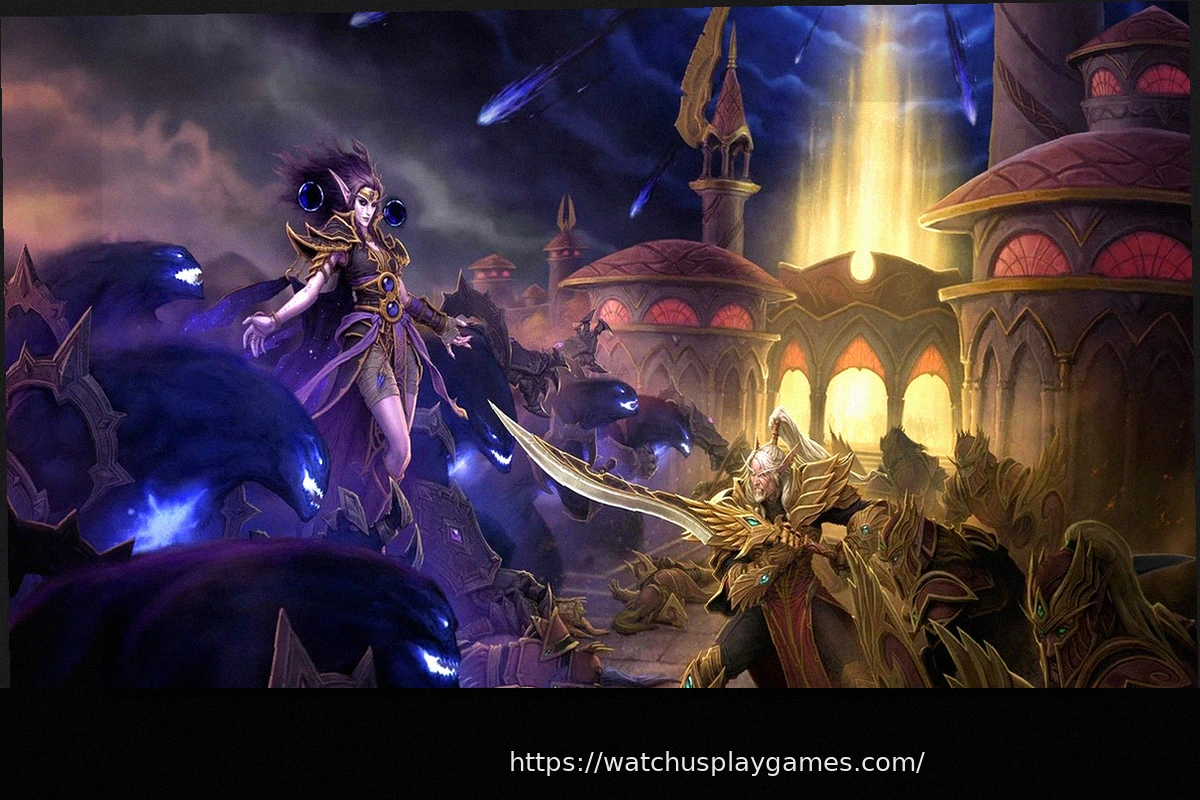
Returning to Azeroth for another World of Warcraft adventure has become a familiar ritual. For two decades, Blizzard has released an expansion roughly every two years, interspersed with updates that keep players engaged, retaining the loyal fanbase while seeking new recruits. Yet, it’s the veterans, those who’ve invested hundreds of hours in their characters, who ultimately matter the most.
The World Soul Saga, a unique trilogy that began with The War Within, continues with Midnight. This expansion carries the significant weight of the “middle chapter problem”: acting as a bridge between an excellent beginning and the eventual conclusion in The Last Titan, Midnight must sustain momentum, keep fans captivated, and attract new players. How has it fared with these substantial responsibilities?
Gathering at the Sunwell?
Before penning this review, we completed Midnight’s introductory campaign and awaited the opening of the first raids – Void Pinnacle and Dreamrift – to conclude this initial narrative arc, which will later continue with The March on Quel’Danas. The choice to launch three smaller raids within a few weeks during Season 1 is unprecedented and reflects Blizzard’s evolving philosophy for this Saga, though it ultimately appears more confusing than genuinely innovative.
The campaign, which begins in Silvermoon City (now a neutral hub for both factions) after a brief introduction, unfolds through three main paths that players can tackle in any order. While this structure has been utilized before, the stories presented left us rather indifferent, despite frequent use of cinematics that, often feeling dated in their execution, tended to achieve the opposite effect of immersion. Arator’s story was the most enjoyable, serving as a clear nod to fans and the long history of Warcraft Paladins, explicitly preparing the character for a leading role. This storyline, perhaps less comprehensible to newer players, unlocks a small, neutral zone called Arcantina, specifically designed for lore enthusiasts.
The questline focused on the Amani Trolls of Zul’aman and Zul’jin’s nephews is more contained and primarily serves to contextualize local events, delving into a Troll culture that is already quite familiar. The last of the three regions, Harandar, exists to justify the introduction of yet another allied race, the Haranir, through a somewhat convoluted explanation: they’ve supposedly lived underground forever, only emerging now that the Sunwell’s dysfunction threatens their existence.
The three narratives finally converge in the Void Storm zone, where the decisive battle against Xal’atath’s forces, threatening to invade Azeroth, takes place. There, in the Void Pinnacle raid, we once again face a Windrunner who has succumbed to darkness. As you might have gathered, the writing of this campaign did not exactly impress us. It persistently emphasizes the gravity of the Void threat without the previously united allies ever truly appearing to lend their aid. In this sense, World of Warcraft continues to suffer from a script that aims for grand beginnings but then scales things down, perhaps due to the inherent difficulty of juggling so many characters and multidirectional connections.
The campaign’s main issue, though it flows fairly well and maintains a good pace, lies primarily in the constant, pervasive sense of déjà vu. This applies not only to the narrative but, even more so, to the environments. Midnight reuses two old zones, Eversong Woods and Zul’aman, now revisited, while Arator’s storyline is set in locations belonging to previous expansions or the original World of Warcraft. Void Storm is essentially a new version of K’aresh, the map added at the end of The War Within, and Harandar is just another subterranean biome reminiscent of Un’goro Crater. Everything feels seen before, already explored, and while map construction is as masterful as ever in terms of geometry and the placement of enemies, treasures, and collectibles, we felt much less incentivized to explore than in the past precisely because almost nothing we saw surprised us.
A Middle Chapter, or Half-Finished?
It’s ironic that the best stories in this expansion are hidden among the hundreds of available side quests, often better written than a main campaign that feels like it’s spinning its wheels around the Windrunner family drama and the machinations of Xal’atath, an antagonist whose story has been overextended across too many expansions, turning her into a Sunday cartoon caricature. The finale of Void Pinnacle hints at a potential narrative revival that could finally involve other heroes of the saga, but it’s too early to celebrate victory.
Midnight’s problem is also that it’s simply an uninspired expansion, even in its artistic direction, making us long for spectacular zones like the Sacred Precipices of The War Within.
It’s unlikely to improve significantly based on player feedback, as it serves as a bridge to the next expansion, The Last Titan, which Blizzard has been diligently working on for some time. In short, we risk playing a “stagnant” expansion precisely because of its intermediate nature, but fortunately, on the gameplay front, we have little to complain about, though it must be clear: World of Warcraft hasn’t changed one bit this time either. But we’ve already said and repeated that it can never truly change, so expecting anything different now that we’re officially in the twenty-second year of Blizzard’s MMORPG makes little sense.
Instead, we can note the subtle adjustments Blizzard makes with each iteration of the game, striving to perfect what it can, even at the cost of seeming a bit monotonous by now. This is the case with the new “Apex Talents,” which reward players in the race to the new maximum level, granting each specialization three new nodes on which to spend extra talent points. They aren’t particularly revolutionary, but they add abilities—mostly passive—that help better express each class’s potential and fantasy. As for balancing, there’s no point commenting: Blizzard will, as always, apply nerfs and buffs each season, overturning delicate balances to reshuffle the deck and perhaps encourage players to level new characters.
The game is thus the same as always, at least for those who, once they reach the maximum level, want to engage in the vertical endgame of dungeons, raids, loot, and PvP (which still exists, despite what some might say). Blizzard has slightly extended the duration of this first season to allow players to align and begin the climb more or less equally, especially now that the initial available raids are two, totaling seven bosses plus a world boss. The third raid will add another two bosses, giving players a baseline of ten raid bosses plus eight Mythic dungeons: for those who want to maximize their gear, there’s plenty to do, between multiple difficulty levels in raids, timed Mythics, crafting, world quests, and skirmishes. Enough to keep the perfectionist player engaged for a long time, without forgetting casual players.
Blizzard’s consideration for less frequent players is now evident, not only in the influx of cosmetic and secondary content—the addition of Player Housing, for instance, has sparked a secondary market of decorations and various amenities for a fantastic feature, but one we fear will appeal to a limited number of players and lose appeal over time—but also in the introduction of mechanics designed for solo players or small groups. Midnight not only adds eight new, excellently crafted dungeons, especially in the design of boss fights that are decidedly more original and complex than usual (we particularly enjoyed Windrunner Spire and Intrigue’s Traverse), but also a new series of skirmishes alongside Valeera Sanguinar, who replaces Brann Bronzebeard from The War Within as the seasonal reference character.
An MMO: Predator or Prey?
Disappointing, however, is the “Prey System,” which was supposed to be the highlight of the new endgame content. Supported by a very interesting miniature narrative arc, the Prey System works like this: the player chooses a target miniboss, which will appear in a specific map unexpectedly while fighting enemies, collecting resources, or performing some other action. These ambushes could occur when the player is at a disadvantage, just as if playing open-world PvP, and the goal is to repel them each time. After a certain number of repelled ambushes, players can finally counterattack and seek out the miniboss for a decisive duel that will earn them reputation with the unsettling Astalor Bloodsworn and a currency to exchange for mounts, pets, and various decorations. On paper, the Prey System seemed very interesting.
In practice, it’s very little. The problem isn’t the ease of encounters on Normal and Hard difficulty—the targets are little more than Rare enemies with limited mechanics—or how frustrating they become on Nightmare, when progression resets with every death or accidental disconnection. Rather, it’s the fact that at a certain point, players find themselves ‘grinding’ resources or enemies solely to trigger the ambushes. Once world quests are exhausted in a map, and thus the reasons to linger in the area, the Prey System shifts from being a secondary activity to complete while doing other things to… doing other things solely to complete the secondary activity: practically the opposite of what the system was intended for.
The Prey System ultimately becomes an alternative to skirmishes for filling the lower row of the weekly Great Vault with high-level loot, useful for casual players who don’t do raids or timed Mythics but much less so for everyone else. And once the Prey topic is exhausted, there’s little truly innovative left to focus on. There’s the “Abundance” minigame, which is cute but not essential, and a series of regional secondary quests that are a bit more intricate than usual, rewarding players with chests full of resources, money, and reputation. But true character progression still revolves around dungeons and raids, and all these small secondary contents, in the end, seem to exist only to give collectors a way to fill up on cosmetics.
The Housing system, for example, is almost intrusive; vendors are now filled with pages upon pages of decorations, often requiring parallel farming of resources or currencies. In some ways, it’s absurd that a feature players requested for so many years is now constantly at the forefront, but then again, World of Warcraft has decided to embrace a plurality of philosophies and players who continue to support its nature as a parallel universe. Midnight, in this sense, succeeds in its primary intent without too much effort: the super-tested loop, based on an almost perfect gameplay (despite balances and imbalances, of course), always works, and thanks to a series of refinements, for example concerning crafting or even just the significantly streamlined gear improvement, it represents a further perfection of the dynamics with which Blizzard has been entertaining players for years.
Despite these considerations, and knowing that we will play at least the first season to exhaustion, trying to climb the Mythic+ leaderboards to unlock new rewards and improve gear, we cannot hide our disappointment with a content package that feels more like a major update than a true expansion. Midnight lacks that sense of wonder and awe that characterizes great expansions where new lands or worlds are explored, where one confronts new, imaginative creatures and gets to know the enemies to be faced in epic battles alongside guildmates (or perfect strangers, if you’re a lone wolf). The new expansion is a constant déjà vu, a return to well-trodden paths, within a campaign that struggles to take off, for the first time serving as a backdrop to established dynamics rather than vice-versa.
Conclusion
World of Warcraft’s new expansion speaks of courage but shows very little of its own. It suffers from all the consolidated limitations of middle chapters in trilogies, which was quite predictable, but Blizzard merely refined established mechanics, adding content and features that had little impact on routines unchanged from The War Within and even previous expansions, to be frank. The game still works wonderfully, don’t get us wrong; those who enjoyed improving their character or collecting everything collectible now have new reasons to play, but while following familiar stories in familiar zones, we missed the feeling of novelty and discovery we’ve experienced in previous expansions. Of course, we are at the beginning, and there are potentially ample margins for improvement, but for the first time in many years, World of Warcraft is severely testing our willingness to bet on its future.
PROS
- Dungeons, raids, and boss encounters remain consistently high quality
- Some secondary quests are genuinely well-crafted
- Abundant content for every player type
- Noticeable improvements to various gameplay aspects
CONS
- A pervasive sense of déjà vu hangs over the entire expansion
- The writing of the main campaign leaves much to be desired
- The Prey system proved rather disappointing
- Player Housing is fantastic, but the decoration system feels intrusive