

Understanding VALORANT’s player count for 2026 involves more than finding a single “official” number. Riot Games doesn’t regularly publish comprehensive statistics, so most figures found online are estimates derived from third-party sources and various methodologies. This guide will clarify what different metrics truly indicate, why values might vary across sites, and what signals are useful for assessing whether VALORANT is growing, maintaining its position, or losing momentum.
How Many People Really Play VALORANT?
When you see numbers like “current VALORANT players” or “players online now,” you’re looking at a snapshot that changes minute by minute. While useful for understanding peak hours, it alone doesn’t reflect the game’s overall vitality.
To navigate these figures accurately:
- Concurrent Players: How many people are in a match or the client at the same time. This fluctuates significantly between morning, evening, and weekends.
- Active Players (30 Days): This is the most stable metric for describing the real player base and is often referred to as VALORANT’s active player count.
- Peaks: High VALORANT player peaks during events or patch releases are normal; what also matters is how quickly numbers return to the average.
A detail often overlooked: two different trackers might use different definitions of “active.” Some estimate from match reports, others cross-reference public signals and trends. The result: different numbers, both plausible in terms of magnitude, but none “official.”
Practical advice for players: To decide if it’s worth returning to ranked play, look at long-term stability (30 days) rather than a single afternoon’s snapshot.
VALORANT’s Growth Trajectory: 2020-2026
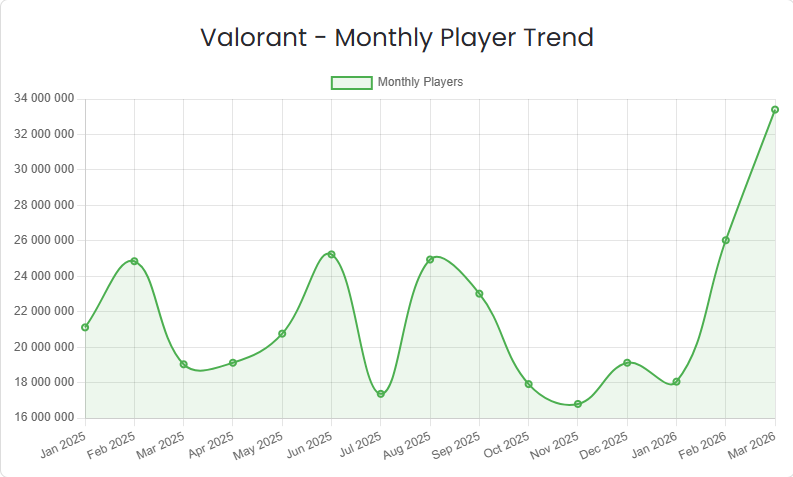
VALORANT launched strongly in 2020, fueled by its beta, curiosity, and the demand for a new competitive title. It then entered the typical live-service game phase: initial growth, stabilization, and subsequent boosts tied to major content updates and the esports circuit.
Several recurring accelerators have shaped its growth:
- New Agents or Maps: These genuinely change the meta and often bring back players who were on a break.
- Episode and Act Starts: Resets, new rewards, and the desire to climb the ranks.
- Major Tournaments: VCT finals, in particular, tend to drive both viewership and in-game activity, as players want to try out comps, setups, and agents seen played by pros.
The key for 2026 is to view it as a year of maturity, not an “end of the road.” When a competitive game stops growing explosively, it often isn’t a sign of decline; it’s when the player base stabilizes and becomes more predictable.
Regional Breakdown of VALORANT’s User Base
The distribution of players is not uniform. Generally, the Asia-Pacific region is often cited as the largest player base, followed by EMEA (Europe, Middle East, Africa) and the Americas. This regional distribution matters for three practical reasons:
- 1) Different Peak Hours: Global numbers sum up prime times across different time zones.
- 2) Meta and Playstyle: Certain regions might emphasize discipline and utility more, while others lean towards faster pace and aggressive dueling.
- 3) Matchmaking Quality: Populated and stable servers tend to offer quicker queues and more “clean” MMR matches.
If you’re interested in understanding where the game is most active, don’t just focus on the “percentage of players.” Also look at indirect signals like tournament density, local content creators, and peak-hour ranked activity.
Player Demographics and Engagement
Industry analyses and trackers frequently report a very young player base, with a strong presence of Gen Z. This aligns with the game’s nature: competitive, social, frequently updated, and heavily influenced by a thriving streaming scene.
Regarding engagement, three patterns consistently emerge:
- Concentrated Sessions: VALORANT is often played in “blocks” of 2-3 games.
- Evening Peaks: The 7-11 PM local time slot is usually the densest.
- Busier Weekends: More free time leads to more parties and ranked play.
Player perception can also play a role. A player might say “there are few people today” because they encountered two unbalanced matches or strange queues. This isn’t necessarily a global decline; it could be a mix of time of day, role, MMR, and region.
A separate note for those seeking information on VALORANT console player count: when discussing player pools and numbers, remember that the console ecosystem has different dynamics. If there are separations or specific rules, direct comparisons with PC become less straightforward.
Rank Distribution in 2026
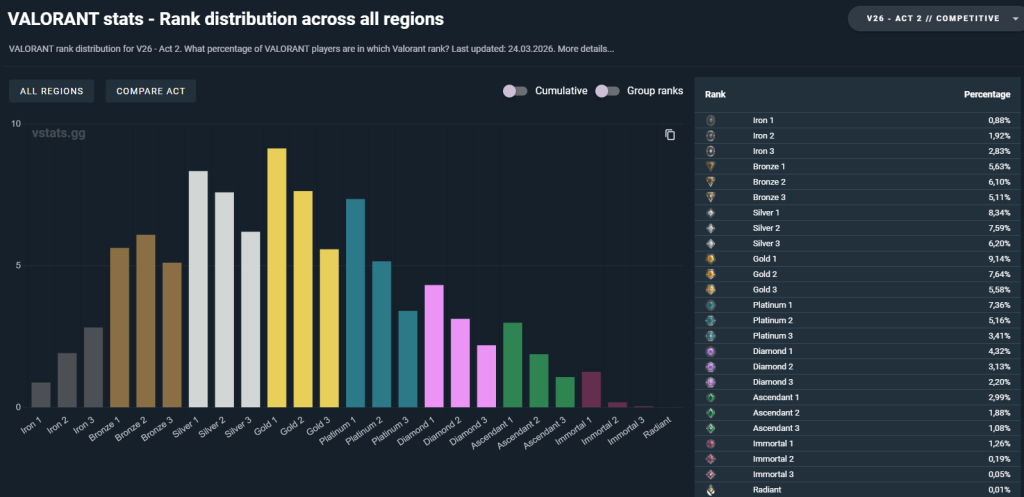
VALORANT’s ranked ladder tends to have a very broad “belly” in the middle ranks. In practice, most players are concentrated between Silver and Gold, with an increasingly thin tail as you ascend to higher tiers.
For players, this means:
- If you are in the mid-ranks, you will find more variability: players climbing, players on tilt, occasional smurfs, and noticeable skill gaps within the same rank badge.
- If you aim for Plat and above, the difference often isn’t just aim. Timing, economy management, trading, and team-oriented utility become crucial.
- From Diamond and up, stability increases. Less time is lost due to basic errors, and every round punishes mistakes more severely.
A common mistake is interpreting rank distribution as a judgment. In reality, it’s a map: it shows you where you stand relative to the majority and how “crowded” your current step is, indicating how much effort is needed to move up.
Esports Popularity and Impact on the Game
VALORANT is one of those titles where esports and the player base mutually reinforce each other. When a major event occurs, three concrete things typically happen:
- Increased Interest: Even non-players return to watch, and often reinstall the game.
- Perceived Meta Shift: Pro players’ agents and team compositions suddenly become “must-try,” even if they don’t always work the same way in solo queue.
- Increased Ranked Activity: More players want to test setups, lineups, and strategies seen streamed by pros.
It’s useful not to confuse Twitch popularity with actual players; they are correlated but not identical. However, when you see sustained growth across multiple signals together, it’s a good indicator of overall health.
If you’re looking for a simple number like “average VALORANT players” or “daily VALORANT player count,” use it as a compass, not as an absolute truth. To truly understand how VALORANT is performing in 2026, the most reliable approach is a combination of monthly trends, peaks during patches, and retention after competitive events.