

Rediscovering Nintendo`s Masterpieces on Switch
The Super Mario Galaxy titles are widely celebrated as pinnacle achievements in 3D platforming for the Mario series. While players might debate the superiority of one Galaxy game over the other, or whether Odyssey now holds the top spot, their continued relevance in discussions solidifies their status as some of Nintendo`s finest releases from the past two decades. Curiously, despite their acclaim, accessing these games has often been challenging. Beyond the original Wii or Wii U, the primary modern option for playing Galaxy was the Super Mario 3D All-Stars collection—a peculiar, limited-time release that notably omitted Galaxy 2. Therefore, the arrival of remastered versions of both Galaxy and Galaxy 2 on Switch and Switch 2 is a welcome development, not just for their improved accessibility, but also for a suite of enhancements that elevate the experience.
For those who already own the All-Stars edition, the remastered Galaxy offers a largely familiar experience, yet the updated package presents a visibly enhanced aesthetic. The visuals are crisper, and user interface elements have been subtly shifted closer to the screen`s edges, maximizing the play area. A newly introduced Assist Mode lowers the difficulty, providing more lives and a recovery mechanic to quickly return to solid ground after a fall—a frequent occurrence given the games` focus on small, spherical worlds. Furthermore, most menus have been redesigned for button-based navigation, eliminating the need for cursor interaction to select stages or advance dialogue.

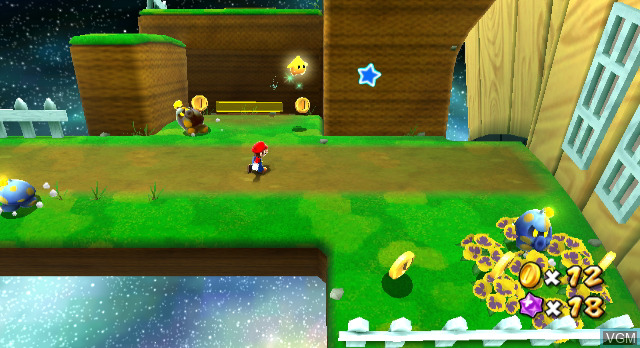
Despite the menu revisions, the cursor remains essential for collecting `star bits`—the vibrant, candy-like collectibles that serve as the primary currency in Galaxy titles, replacing the less common traditional coins. Players must still manually sweep the cursor across the screen to gather these bits, or rely on a second player for assistance. This specific gameplay mechanic is arguably the aspect that has aged the least gracefully. An auto-collection option, even if it meant a slight compromise on perfect collection, would be a welcome addition to bypass constant cursor management.
Joy-Cons emulate the Wii Remote`s functionality directly. With a Pro Controller, tapping the R button re-centers the cursor, and subsequent motion controls allow calibration regardless of screen orientation. Handheld mode utilizes touch input for cursor control. While Joy-Cons offer the most intuitive experience, all control schemes are adequately functional. Additionally, the spin attack, originally performed with a wrist-flick, can now be executed by pressing a button, a feature also present in the All-Stars release.
These subtle refinements, consistent with their status as remasters rather than full remakes, collectively enhance the brilliance of the games. Both Galaxy and Galaxy 2 stood out as exceptional titles, rapidly introducing a rich array of innovative concepts. The fundamental gameplay—Mario traversing relatively small planetoids, each with its unique gravitational pull—transforms platforming into a series of inventive, improvisational challenges. Level design is a constant cascade of fresh ideas, ensuring no single mechanic overstays its welcome. One minute, players might be strategizing a path through a planet`s core to reach an opposite platform; the next, they`re gracefully leaping between star nodes, executing precise wall-jumps across demanding sections, or engaging in combat with cosmic dragons. This unprecedented, rapid-fire creativity distinguishes these games within the 3D Mario canon.
However, this distinct approach introduces camera perspectives that can occasionally prove challenging. Unlike the side-scrolling views of classic 2D titles, or the behind-the-back angles of Mario 64, Sunshine, and Odyssey, the Galaxy games (particularly the first) frequently position the camera above Mario, or with a slight, unconventional offset. This can sometimes lead to awkward moments and minor directional disorientation. While not a constant issue, it undeniably sets these games apart from other Mario adventures. Galaxy 2 mitigated this concern by predominantly featuring larger planetoid structures. Although still unique, the sequel incorporates more traditional level layouts and fewer of the diminutive, pill-shaped worlds.

Super Mario Galaxy 2 often feels like a more refined and concentrated evolution of the initial concept. Where the first game heavily emphasized the debut of Rosalina and her narrative unfolding at the Comet Observatory, Galaxy 2 adopts a much tighter focus. It features a more direct map progression and a less expansive hub ship. This design choice suggests Nintendo prioritized allocating resources to the intricate level design, making it the superior game in many respects, even if its narrative presence is less prominent than its predecessor`s. Furthermore, it boasts improved power-ups; Cloud Mario, with his ability to conjure temporary platforms, stands out as an iconic Mario innovation, making its absence in subsequent titles a pity. However, for better or worse, Galaxy 2 also integrates the cursor more deeply into core gameplay, not merely for gathering star bits, but for essential platforming actions like Yoshi`s tongue attacks on enemies and objects. Players hoping for a completely cursor-free experience will find this impractical for significant portions of Galaxy 2.
The Super Mario Galaxy games earned widespread acclaim as some of the finest entries in the Mario franchise. As a duo, they exhibit remarkable synergy. The original Super Mario Galaxy stands as a groundbreaking, `idea-a-minute` reinvention that introduced beloved characters like Rosalina and the Lumas to the Mushroom Kingdom. In contrast, Galaxy 2 serves as a streamlined, `no-filler` refinement, pushing its foundational concepts to their absolute limits. Collectively, they form a crucial chapter in Mario`s legacy and remain enduring examples of the series` pinnacle achievements.