

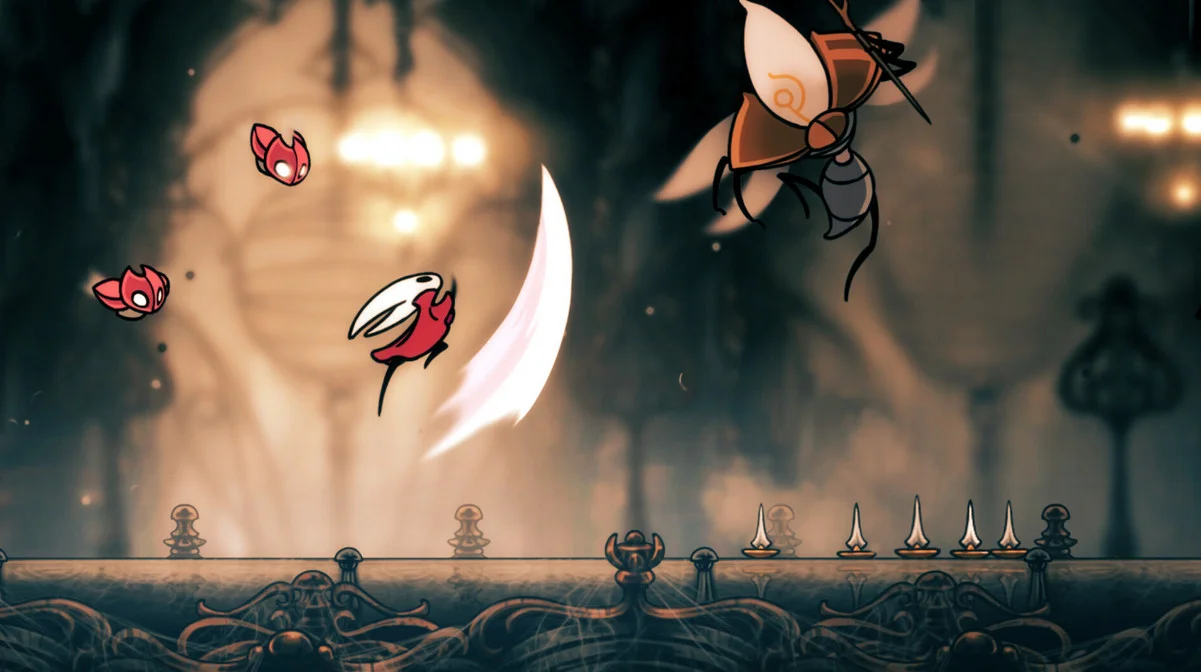
The long-awaited sequel to Hollow Knight delivers a punishing experience, a deliberate choice by its developers, Team Cherry, influenced heavily by its protagonist, Hornet.
After an eight-year wait, Silksong has finally launched, and players are quickly discovering its significant challenge. Many consider it substantially more difficult than its 2017 predecessor, Hollow Knight. This increased difficulty, however, is a conscious design decision, as revealed by Team Cherry in a recent interview.
During the ACMI Game Worlds exhibition in Melbourne, Team Cherry co-director Ari Gibson and developer William Pellen spoke with co-curator Jini Maxwell for her upcoming book, “The ACMI Guide: Hollow Knight Silksong.” In their discussion, Gibson and Pellen elaborated on why the sequel presents a tougher experience, largely attributing it to the unique playstyle of Hornet.
Team Cherry explained that in designing the game around Hornet as the playable character, they had to elevate the strength and complexity of her adversaries. Their overarching philosophy was to “bring everyone else up to match [Hornet’s] level” of agility and combat prowess.
Gibson noted, “Hornet is inherently faster and more skillful than the Knight, meaning even the most basic enemies needed to be more intricate and intelligent.”
Pellen further detailed this, stating, “The foundational ant warrior`s move-set is derived from Hornet`s original boss encounter, incorporating her dashes, jumps, and downward strikes. We also gave them the ability to evade and counter. Unlike the Knight’s foes, Hornet’s enemies required more diverse methods to catch her as she attempts to disengage.”
This design approach clarifies why seemingly common foes in Silksong can feel incredibly formidable. When it comes to bosses, such as the Savage Beastfly or Sister Splinter, Team Cherry offered a less direct explanation, though Gibson emphasized that the multitude of “choices” available to players should help alleviate frustration.
Gibson highlighted, “Our core principle is to allow players significant freedom to explore off the beaten path. One player might follow a linear progression, while another might constantly deviate to uncover hidden elements, alternative routes, and secrets. Silksong certainly has moments of intense difficulty, but this enhanced freedom within the world means players always have options regarding their exploration and approach.”
If players encounter a particularly challenging boss, like the Widow, Team Cherry is not overly concerned. Gibson explained that the Metroidvania genre inherently provides players with various ways to overcome obstacles beyond simply repeatedly attempting a difficult fight.
“That’s perfectly fine,” he affirmed. “Players possess methods to mitigate difficulty through extensive exploration, learning new tactics, or even entirely circumventing a tough challenge, rather than becoming completely stuck.”
Despite these design philosophies, the punishing nature of the sequel is undeniable. The community has responded by creating mods to ease the difficulty, and Team Cherry itself has released patches to make the game more accessible, alongside planned updates for bug fixes (distinct from the in-game insect enemies). It’s clear the studio is well aware of its sequel`s high difficulty. Nevertheless, Silksong has reportedly sold over four million copies since its September 4 launch, proving that challenging games can indeed be highly successful.
Hollow Knight: Silksong is currently available across a wide range of platforms, including Nintendo Switch (both current and the upcoming Switch 2), PC, PlayStation 4, PlayStation 5, Xbox One, and Xbox Series X|S.