

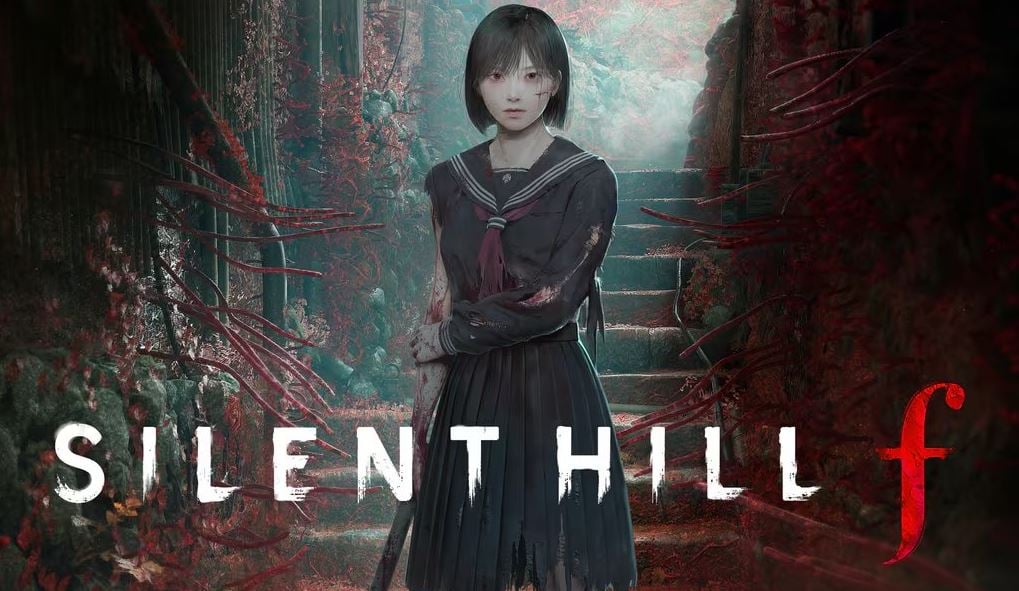
During my initial conversations with the Silent Hill f development team at Konami`s Tokyo headquarters, veteran composer Akira Yamaoka revealed the guiding principle behind his score for the new game: wabi-sabi. As I interpret it, wabi-sabi celebrates beauty found in life`s transience—its imperfections, impermanence, aging, and decay. Yamaoka aimed to infuse his compositions with a “sense of time passing,” an ambition I believe he thoroughly achieved based on my gameplay experience. More profoundly, Yamaoka`s insight illuminated the deep emotional resonance of Silent Hill f, a game that has stayed with me long after playing.
Silent Hill f masterfully intertwines beauty with decay: blooming flowers consume flesh, and ancient structures succumb to viscous rot. This pervasive grotesqueness is paradoxically stunning, both aesthetically and in the profound melancholy it evokes. The game`s visual artistry deeply impressed me. Furthermore, Silent Hill f`s characteristic exploration of the human psyche, here focused on a young girl`s jarring transition into womanhood, resonated with my own adolescent experiences—a period that felt both isolating and terrifying, yet also precious and foundational, a part of my past that has, in a way, withered. Few games achieve such a powerful emotional impact in less than six hours, but Silent Hill f succeeded.
My experience with Silent Hill f left me utterly captivated and profoundly impressed. While last year`s Silent Hill 2 remake hinted at a revival for the franchise, lingering doubts about the series` true return persisted. Now, I can confidently declare that Silent Hill is not only back but appears to be stronger than ever, with Silent Hill f poised to become the franchise`s pinnacle.
This is a significant assertion, particularly as Silent Hill f marks a definitive departure from the iconic foggy New England setting. While other Silent Hill titles have ventured beyond the town`s physical boundaries, this entry fully embodies Konami`s concept of Silent Hill as a psychological space. For the protagonist, Hinako, this manifests as a nightmarish, decay-ridden version of her Japanese rural hometown, Ebisugaoka. The game further differentiates itself by moving from contemporary settings to the late 1960s, a decade chosen by the developers to symbolize the clash between Japan`s idealized past and its impending technological future.
The narrative of Silent Hill f rapidly unfolds, maintaining a potent sense of dread. Following another parental dispute, Hinako leaves home, seeking any company to distract her. Her actions and journal entries portray her as profoundly lonely, despite seemingly having friends and a supportive older sister she adores. This vulnerability immediately made her relatable. Soon, as she descends into Ebisugaoka`s foggy, Kanayama-esque alleys, Hinako is plunged into a classic Silent Hill nightmare, complete with intricate social dynamics and an eerie, yokai-infested spirit world. This alternate dimension is as captivatingly dark and beautiful as it sounds, making me eager to revisit it even while exploring the main town.
Hinako, a high school student, is far from a combat specialist. While she can wield a metal pipe and, in the spirit world, ceremonial daggers and a naginata, her athletic background makes evasion the preferred strategy. Silent Hill f emphasizes resource management, reintroducing weapon degradation, a feature that can be divisive but here perfectly complements the game`s pervasive theme of decay—both physical and psychological.
Extending the theme of degradation, Silent Hill f introduces a sanity meter alongside the usual health and stamina bars. While such mechanics can sometimes feel tacked on, I found this addition to be thoughtfully implemented. It avoids misrepresenting mental health and feels organic, empowering Hinako with a unique “focus” ability. When activated, this ability highlights optimal moments for critical strikes. However, intense observation drains her sanity, and once depleted, she must rely solely on her own judgment to identify vulnerabilities.
Beyond weapon degradation, Silent Hill f introduces a novel resource management layer through its permanent upgrade system. Shrines found in Ebisugaoka and the spirit world serve as save points and allow Hinako to generate “faith” by enshrining items, including healing consumables. This faith can then be used to draw “omamori” (random accessories with boons) or permanently enhance her stats. This system creates a compelling strategic dilemma: should players conserve valuable healing items for immediate combat needs, or sacrifice them for long-term character progression? While some items are strictly for enshrinement or consumption, many offer players a meaningful choice in how they manage their resources.
Overall, Silent Hill f`s combat proved enjoyable, feeling more fluid than previous installments, with Hinako`s attacks and defensive maneuvers possessing a satisfying heft. While not groundbreaking for action, it fits well within a psychological horror context. A minor issue arises from the necessity of resource conservation and battle avoidance, which often involves navigating Ebisugaoka`s cramped alleys. Although tight spaces and a close camera enhance the game`s tension, it can become frustrating when pursued by a grotesque enemy with a slow-recovering stamina bar impeding evasive actions. This occasionally shifted the emotion from dread to irritation, leaving me wishing for quicker stamina regeneration, even after applying upgrades.
However, the Silent Hill series is renowned for its exceptional level design and puzzles, and Silent Hill f excels in both areas. Ebisugaoka, mirroring its namesake, is a stunning yet unsettling and anxiety-inducing environment, a true pleasure to navigate despite its monstrous inhabitants. It`s surprisingly expansive and less linear than anticipated. Certain locations feature self-contained side stories that, while optional, influence Hinako`s eventual ending in subsequent playthroughs (the first playthrough is fixed to the canonical ending), significantly enhancing the incentive for exploration.
Consistent with the series` tradition, Silent Hill f features compelling set pieces, from expansive farmlands and shadowy temples to a decaying middle school—a location that will particularly resonate with fans of Silent Hill 2`s apartment complex. While the puzzles weren`t overly challenging, they offered engaging intellectual diversions, requiring me to inspect scarecrows, decode cryptic locker messages, and match omamori symbols to long poems, among other tasks.
It would be an oversight not to commend Silent Hill f`s exceptional music and sound design, hallmarks of the series. Composer Yamaoka masterfully blends classic Silent Hill motifs with traditional Japanese instruments, visceral vocalizations, and a children`s choir, creating a profoundly haunting atmosphere. The immersive 3D sound design further envelops the player in this terrifying world.
Even superficially, Silent Hill f offers an outstanding experience. Its initial five hours present a compelling narrative of a young girl navigating decaying environments and teenage psychological struggles, drawing me in completely. Yet, the game also invited a deeper dive—into Hinako`s inner world and the profound implications of growing into womanhood in 1960s Japan.
I was somewhat surprised to find such explicit exploration of these themes in Silent Hill f, especially in the current media landscape. While horror excels at addressing adolescence and womanhood—and Silent Hill itself has done so subtly in the past—video games rarely tackle these subjects head-on. In my interview with the Silent Hill f team, I inquired if they intentionally explored gender roles, male-female relationship dynamics, and the “horrors” of teenage girlhood. Ryukishi07 affirmed that this was a deliberate focus, one he invested “a lot of effort into depicting purposefully,” and it`s evident in the game.
Ryukishi07 explained, “Given that the protagonist is a girl, it felt crucial to delve into aspects most intimate and personal to her. From her viewpoint, significant relationships include those with her family and her friends. Her family dynamic, in particular, is perhaps the most visceral and deeply personal. These are areas I meticulously sought to portray.”
While the full narrative arc is yet to be revealed, I`m profoundly impressed by Konami`s confident, subtle, and incisive portrayal of a young girl`s psyche and the profound isolation of transitioning into womanhood. From remarks about Hinako`s “manly” speech, to subtle undermining of her femininity by supposed friends, the evolving tension with a male friend as romantic interest surfaces, and trivial magazine articles touting “a woman is only complete once she is loved,” to the most poignant—Hinako`s journal entries detailing her older sister`s ruined marriage and her parents` abusive dynamic—Silent Hill f fearlessly immerses players in Hinako`s internal world.
Furthermore, another compelling element for exploring Hinako`s inner world is an enigmatic, unnamed masked figure who is sure to become a fan favorite. While I can`t reveal much about him, those drawn to compelling, ambiguously benevolent antagonists will find him fascinating. After encountering this white-haired, demon-like character several times—watching him gently guide Hinako through the dark spirit world he appears to inhabit—I felt compelled to ask the developers if they intentionally designed a character to generate such widespread fascination among fans.
Director Al Yang chuckled, confirming, “Yes, that`s the immediate answer. He`s certainly going to appeal to many. Within our own team, roughly half find him charming, while the other half express distrust. This dichotomy is precisely what we aimed for, as it encourages varied interpretations, especially as the narrative deepens.”

The masked figure and the evolving nature of “Silent Hill” are just two of many enigmas within Silent Hill f. Since its announcement, the meaning of the small red `f` in the title has sparked numerous theories, with “forte” being a popular guess due to its stylized shape. However, the development team has remained tight-lipped. Their comments, combined with the revelation of five distinct endings (including a UFO one!), suggest the `f` holds multiple interpretations, inviting players to draw their own conclusions.
Thankfully, players won`t have long to unravel these mysteries and decipher the true meaning of `f.` Silent Hill f is scheduled for release on September 25, 2025, across PC, PS5, and Xbox Series X|S.