

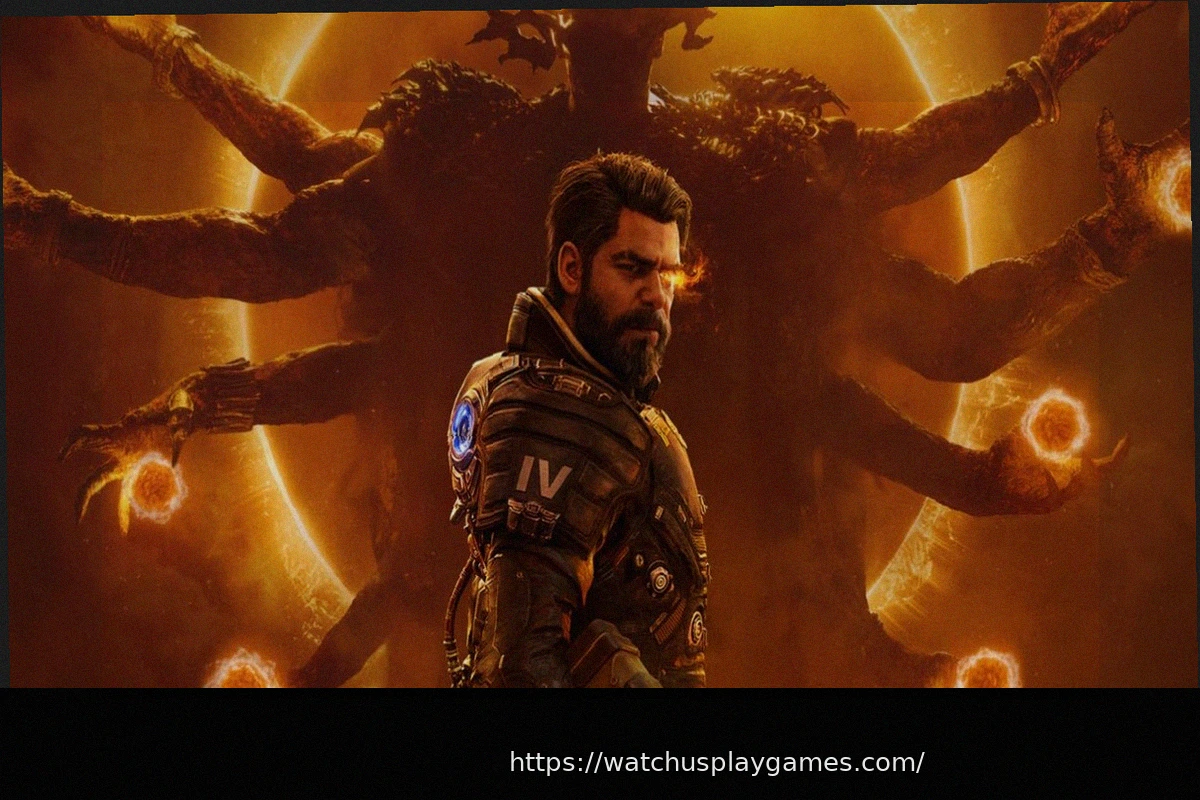
My anticipation for SAROS was immense. I’ve been craving a dose of chaotic action, and the moment I learned of Rahul Kohli’s involvement, my interest skyrocketed. While I typically steer clear of PlayStation exclusives due to shared console use, SAROS might just be the game that compels me to monopolize the console.
Rahul Kohli is widely recognized for his captivating voice acting, memorable roles in Mike Flanagan productions, and recent contributions to Diablo content. I’ve long been an admirer, not just for his acting prowess, but also for his compelling personality and active social media presence. My excitement reached new heights upon discovering he would not only lend his voice to SAROS’s protagonist, Arjun Devraj, but also serve as the character’s face and motion capture model. After approximately three hours of gameplay, during which I repeatedly experienced Arjun’s demise, I can confidently state that both SAROS and Kohli’s performance have thoroughly impressed me.
Online discussions frequently label SAROS as the “spiritual successor” to Housemarque’s previous title, Returnal, which launched in 2021 and later on PC in 2023. A presentation from Housemarque and their PR team offered clarity on this comparison, categorizing it into three aspects: preservation, improvement, and innovation. The studio aims to uphold its hallmark stunning audio-visuals, exhilarating action, and haunting narratives, while simultaneously showcasing the full capabilities of the PS5.
Housemarque’s vision for SAROS includes evolving combat and controls, enriching the world-building, and ensuring an autosave system is available from launch.
Specifically, with SAROS, Housemarque sought to refine combat and control mechanisms, deepen the game’s lore, and implement an autosave system right from release (a feature they mentioned with a knowing “You’re welcome” and a chuckle). New additions include a permanent progression system, a comprehensive ensemble cast, and an innovative mechanic named The Eclipse.
For this preview, I will refrain from discussing much of SAROS’s story. Housemarque titles are known for valuing their narratives and rich worlds, and I believe premature spoilers would diminish the player experience. My notes contain several story-related observations, but the deeper I delved, the more I wished for others to discover them as I did.
My playthrough covered the initial three hours of SAROS, including the tutorial and introductions to many key characters. You embody Arj, as mentioned, but after your first death, you awaken to find you’ve been absent for days, though it felt like mere hours to you. As you traverse the world of Carcosa, through cycles of death and rebirth, and by deciphering numerous logs discovered during your runs, the narrative gradually unfolds, slowly revealing what has transpired and everything you’ve missed.
Even three hours into the game, it was evident that several gameplay mechanics remained undiscovered. At this stage, I had access to standard weapons (such as rifles and pistols) and a powerful “Prominence” weapon. Your shield allows you to absorb enemy projectiles to charge your Prominence for bursts of damage or to counteract “corruption,” a concept I’ll touch upon later. Exploring Carcosa, there were clear areas I couldn’t yet access, and what appeared to be grappling hook points suggesting future navigation.
SAROS is a roguelike that rewards every run through its permanent progression system. Each time you die, resources like Lucenite, collected at a hub called the Primary, can be spent to gain bonuses to various skills, improve resource collection rates, and even unlock access to stronger weapons. Progression through the skill tree is also gated by “Overlord Nodes,” requiring you to locate and defeat powerful Overlords scattered across the map.
During your exploration of Carcosa, after each death, you’ll discover the world has completely transformed. This dynamic environment is even reflected in the dialogue, with Arj and other characters commenting on its ever-changing nature. Arj also ponders his persistent return, searching for something yet unknown, unwilling to give up until he finds it.
In each run, you’ll collect Artefacts, much like in Returnal, which provide temporary aid. Many offer bonuses to attributes like Command, Integrity, and Resilience. However, as my runs lasted longer, I noticed many also came with negative side effects, such as stalling your weapon or reducing available dashes. I also learned the hard way about the limited number of Artefact slots and the inability to swap them once full, leading to stressful decisions about what to pick and what to leave behind.
The final gameplay mechanic I wish to highlight is The Eclipse—and indeed, it sounds as ominous as it is. Upon reaching The Eclipse, enemies become more formidable and begin to utilize corrupted projectiles. These cannot be absorbed for power by Arj and instead pose a significant threat. My play session was nearing its end by the time I encountered The Eclipse, so my focus was purely on survival. However, I had the opportunity to speak with SAROS’s Creative Director, Gregory Louden, who shed more light on the mechanic and how it can be leveraged:
“…we always give you the ability to choose when to call The Eclipse. So in some biomes later in the game, it’s going to be a choice right from the get-go. Do you just escalate the world? Do you change Carcosa to be burning red from The Eclipse, to change the musical score when The Eclipse washes over and also have the kind of Eclipse escalation gameplay?”
He further elaborated on how gameplay shifts during The Eclipse: “So that gameplay, even though it does add additional challenge, it also provides additional opportunity. The resources you collect to come back stronger, the way that you can overcome challenge. I don’t know if you noticed, but when you’re in The Eclipse you actually get more of that resource. So it’s almost in your interest to get to the device, call The Eclipse, collect all the resources you can, and then when you do succumb to the elements, you can essentially go back, upgrade yourself and then hit back hard and beat that boss.”
By this point, I was also confronting some of the game’s tougher adversaries, including bosses and minibosses. During the briefing, Louden stated, “Easy to pick up, but hard to master.” He was absolutely right. My initial runs were filled with false confidence, but the first miniboss utterly decimated me. With each subsequent run, I improved slightly, beginning to discern patterns and mechanics, though it remained an exhilarating challenge. The nightmarish character models, featuring creatures twisted with elements of nature, wings, tentacles, and multiple eyeballs, only amplified the intense atmosphere.
With only three hours of hands-on time with SAROS, I can confidently say that Housemarque has another hit on its hands.
I mentioned being captivated by Kohli’s performance. Beyond the authentic cutscenes and intricate dialogue, Housemarque’s masterful combination of music, voice acting, and sound effects truly makes SAROS stand out. The grunts, panting, and heavy breathing after a battle effectively convey the significance of each skirmish. The soundtrack, paired with the DualSense controller’s vibrations, occasionally makes the experience feel like a rhythm game. Housemarque has dubbed this a “bullet ballet,” and after playing SAROS, I now completely grasp their meaning.
When asked for tips for new players entering SAROS, Louden expanded on the concept of the bullet ballet: “We’ve developed this game to always be basically it’s all about bullet interaction. Returnal is about avoidance. This game is about running into the bullets and actually using them. So the biggest tip I have is do not be afraid of projectiles. They’re not danger. They’re actually opportunity….Go into SAROS ready for the bullet ballet and be ready to dance with the bullets. Don’t run away, run towards them.”
Naturally, the full SAROS experience remains to be seen, but with its exceptional visuals, otherworldly audio, intriguing story, and satisfying combat, players have every reason to be optimistic. After just three hours of hands-on time, I can confidently say that Housemarque has another potential hit on its hands. Even this early in the year, I foresee it earning nominations for, at minimum, Best Audio & Sound Design and Best Action Game, and I wouldn’t be surprised to see it contend for the 2026 Game of the Year award.