

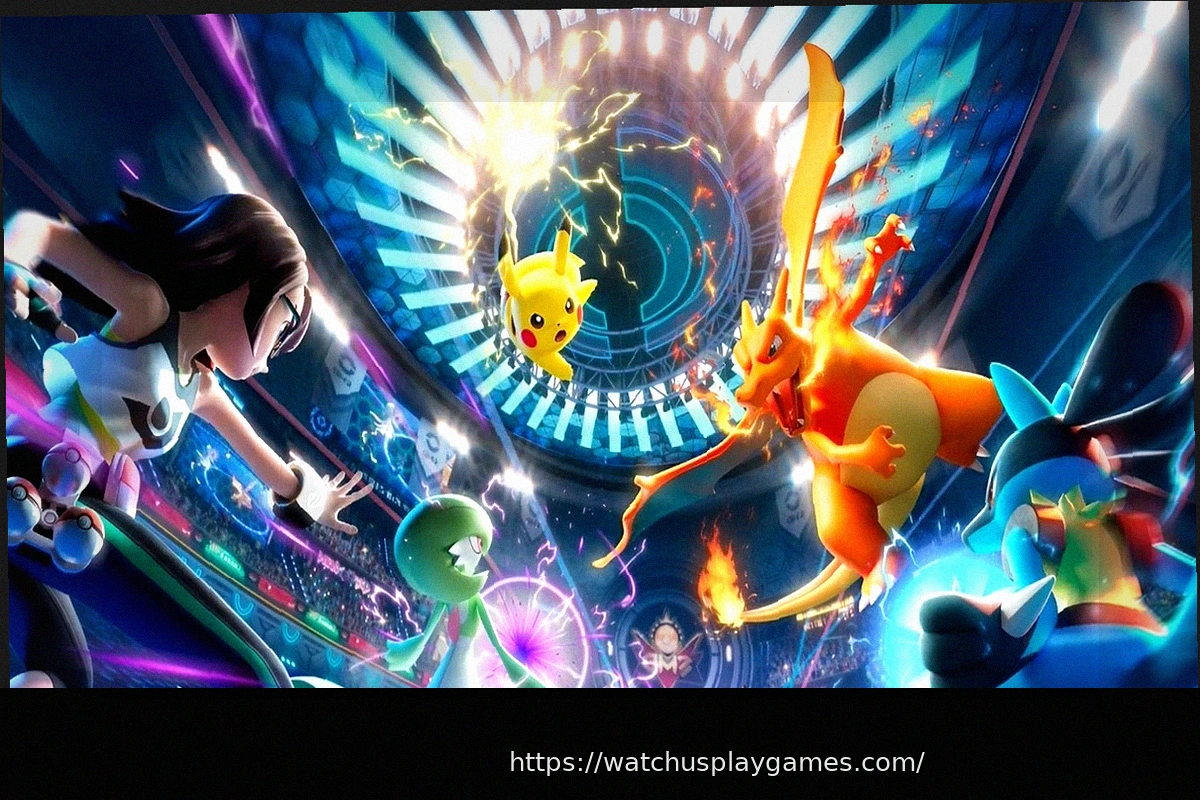
Since The Pokémon Company lifted the curtain on Pokémon Champions during the Pokémon Presents on February 27, 2025, the competitive community has been buzzing. This isn’t a traditional installment in the saga: there are no badges, no gym leaders, no adventure to complete. Champions is a title designed entirely around battle, structured as a live service intended to last forever. Or at least, to last as long as Pokémon themselves, as project lead Masaaki Hoshino emphasized.
Available on Nintendo Switch (and Switch 2 via backward compatibility) starting April 8, 2026, and subsequently on iOS and Android later that summer, the game is poised to become the official reference point for VGC tournaments – already confirmed as the platform for the 2026 World Championships in San Francisco.
During the European Championships in London, we not only witnessed one of the season’s most important esports events but also had the chance to play for the first time what is arguably The Pokémon Company’s most ambitious move in 30 years.
The Japanese company, often accused of stagnation, has decided to break the dichotomy upon which the series has always rested: the indissoluble link between a main chapter and competitive play.
Breaking Down Barriers
One of the secrets of the Pokémon series, an element that has contributed to its global success, is the fact that behind the colorful and innocuous facade of pocket monsters hides a complex video game with unforgiving mathematics. Pokémon Champions, the players, reach the pinnacle of success after months of intense training, dedicated to understanding their team’s effectiveness, the synergy between moves and types, and the search for the perfect Pokémon through breeding, exhaustive training, and so on. This mix of talent and dedication inevitably kept new players at bay: it wasn’t enough to catch or evolve a Rillaboom to have a champion; it had to be meticulously raised and trained to possess the right stats and abilities to face other teams.
Masaaki Hoshino approached Champions similarly to Pokkén Tournament: his goal is to make an extremely competitive and niche genre accessible to everyone, trying to break down entry barriers to focus on gameplay and competitions. Additionally, he aims to create a unique platform for competitions, capable of evolving over time and more dynamically than in the past. In other words, a game-as-a-service, with its own rules, limits, but also undeniable potential.
Platforms and Backward Compatibility
As mentioned, the game will arrive on Nintendo Switch on April 8, 2026. Simultaneously, Nintendo Switch 2 owners will be able to download a free update that improves graphic quality on the new console, keeping the content unchanged. The iOS and Android mobile versions are expected in summer 2026, without a precise date yet.
Naturally, the game will be free-to-play, cross-progression, and cross-platform. In simpler terms, this means not only will it be possible to play with everyone regardless of their platform, but your game progress will be available wherever you choose to log in, much like with Pokémon Unite.
Champions was developed by The Pokémon Works – a joint venture formed in 2024 between The Pokémon Company and ILCA, the studio already responsible for Pokémon HOME support – with the strategic direction of Masaaki Hoshino, a veteran with production credits on Pokkén Tournament and Pokémon Unite.
Economic Model: Free, but with an Asterisk
The game will be free to download on all platforms, but inevitably, there will be mechanisms that encourage microtransactions. For example, a paid Starter Pack will be available from launch, which includes additional Pokémon storage space, battle music from Pokémon: Let’s Go Pikachu! and Let’s Go Eevee!, 30 companion tickets, and 50 training tickets. With real currency, The Pokémon Company is expected to offer accessory items such as new music, inventory spaces, and outfits, not elements that will affect the balance of the experience.
There will also be a free Battle Pass and a Premium one that includes a greater number of items, Mega Stones, outfits, icons, and more. A subscription will allow for increased storage space, more available team slots, access to special missions, and unlock additional battle music. European prices have not yet been officially announced, but the Battle Pass is expected to cost around 9 euros per season, the Starter Pack 5 euros, while the subscription would be 4 euros per month.
Similar to Pokémon GO and Unite, the potential to drive purchases will lie in the customization of your avatar and your Pokémon, with the hope that it won’t lead to the currency chaos of the MOBA, which could deter many. What is certain is that Victory Points (VP) cannot be purchased and must be earned through gameplay.
How are Pokémon Recruited?
The recruitment system works in two distinct ways. The first is transfer from Pokémon HOME, the application that serves as the central hub for all Pokémon experiences. Players will be able to bring creatures obtained in the main series games and Pokémon GO into Champions, provided that the species are present in the game’s Pokédex. Pokémon transferred from HOME are considered ‘guests’ and can be sent back; if trained in Champions, they will retain the training results upon return to HOME, unless their form changes. If they acquire Champions-specific moves, they will lose them when returning.
The path from HOME to Champions remains one-way for Pokémon originally obtained directly in the game: pocket monsters acquired in Champions cannot be deposited in HOME or transferred to other titles in the series, a choice that evidently addresses competitive balance needs.
The second method is internal to the game. Once a day, you can choose one Pokémon from a random selection of 10 pocket monsters to add to your group. These Pokémon are temporary and usable for only one week unless you decide to use Victory Points to keep them permanently. Naturally, there will be methods to perform more than one extraction per day using different in-game currencies. Once you have obtained at least 6 Pokémon, you can organize a team with which to jump online.
How to Play
Once on the field, the differences between Pokémon Champions and what has been seen so far in the main chapters are minimal. After all, the gameplay is still built on the rules established by Shigeki Morimoto 30 years ago in Red and Green, rules that the brilliant Game Freak programmer still expands and manages for the company.
Simply put, it’s as if The Pokémon Company has taken the entire structure of online battles from Scarlet and Violet and made it a standalone experience, without too many variations. All those familiar with the series, therefore, will have very little trouble navigating the in-game menus, as everything is where you expect it to be and works as intended, without significant changes.
So, we are facing a classic turn-based combat system where two teams of 6 Pokémon face off in single or double battles. The course of the battle is also classic, with trainers deciding the move or item to use before each turn, then seeing the outcome of their strategy on the field. All the system of strengths and weaknesses arrives unchanged in Champions from Scarlet and Violet, with only the addition of some specific moves for certain Pokémon (like those seen in Z-A) and the possibility, based on seasonal rules, to mix, for example, Z-Moves with Mega Evolutions.
Naturally, victory goes to whoever manages to defeat all opposing Pokémon.
The Victory Point System
One of Champions’ major innovations, and the reason we assert that entry barriers have been broken down, is the abandonment of the traditional IV and EV system. Champions replaces years of breeding and farming with a more direct system where Victory Points can be spent to freely change Pokémon’s moves, modify their nature, alter abilities, and completely adjust their stats. Each Pokémon, in fact, has 66 points that can be distributed according to what we believe are our needs. In other words, two Dragonite won’t necessarily be identical but can have different setups, depending on whether you want to make them strong in attack or defense. All this will simply depend on trainers’ choices and not on chance or complicated breeding formulas between pocket monsters.
VP can be used to buy items to bring into battle, such as Mega Stones, various helmets or potions, clothes, music, and poses to show off at the end of a battle.
When the game launches, it will be interesting to see what veterans think of all this: on paper, ‘only’ all the work needed to get perfect Pokémon has been eliminated, leaving the gameplay intact: will it be enough not to lose strategic depth?
The Three Game Modes
Battles are available in three formats: Ranked Battles, where you compete against trainers of similar skill aiming for the top of the global leaderboard; Casual Battles, without recording wins and losses, for free experimentation; and Private Battles, with dedicated rooms for challenges among acquaintances. All three formats support both Single and Double Battles, with the latter using the classic format of choosing four Pokémon from a team of six for each encounter.
Online Competitions are also planned, with predefined rules that change after each season. Masaaki Hoshino’s objective is to keep the game fresh through the rotation of rules, pocket monsters, and so on, thus shaking up the meta every few months with the introduction of new rules, balances, but most importantly, gimmicks.
Mega Evolutions and New Abilities
One of the project’s most delicate aspects is how Champions will manage to unite all the different moves seen over the years. In the game, each trainer will have a device called the Omni-Ring that is potentially capable of activating every type of power, from Terastallization to Z-Moves. But how will these interact with each other? According to Hoshino himself, balancing these ‘super moves’ will be the development team’s most complex task. Because while we’ve seen how these abilities interact in the latest season of the anime with Ash, creating a balanced competitive game around all of this is decidedly more complex.
For now, there are only past abilities, but soon those characterizing new main series titles, starting from Pokémon Legends: Z-A, and extending to Pokémon Wind and Pokémon Wave, will be introduced. For example, the first to be added to the current meta will be some creatures from Z-A like MegaMeganium, MegaEmboar, and MegaFeraligatr, all three characterized by special moves not previously available on the competitive scene.
Launch Bonuses and Link with Legends Z-A
Players who download the game by a certain date will receive a Dragonite directly in their in-game mailbox. By transferring Chesnaught, Delphox, Greninja, and Eternal Flower Floette from Pokémon Legends: Z-A to Champions via HOME, players will be able to obtain their respective Mega Stones. This connection between the two titles is not coincidental: MegaDragonite is one of the Mega Evolutions also announced in Legends Z-A and will be available from Champions’ launch.
Official Competitive Calendar
The VGC will transition to Pokémon Champions as the standard platform for all competitive matches starting with its Nintendo Switch launch on April 8, 2026. The Indianapolis Regional Championship will be the first official Pokémon Championship Series event to exclusively use Champions as its platform. The event will take place from May 29 to 31. Champions will then be the platform for all subsequent Premier events, including the North American International Championships from June 12 to 14 and the World Championships from August 28 to 30. Those who don’t want to wait for Indianapolis can play Champions in an official context even sooner: Global Challenge I will be held from May 1 to 4 and will use Champions with Regulation M-A, although it will not award Championship Points in TPCi-managed regions.
The transition will occur gradually: for regional tournaments in April and May, Champions will be used in secondary tournaments, while for the 2027 season, Champions will become the mandatory platform for all Championship Point-awarding events.
With Pokémon Champions, TPCi attempts its most ambitious move in 30 years: separating the competitive soul from the main chapters. In doing so, it seeks to increasingly open its esports ecosystem to a wider audience, reaching them on iOS and Android and eliminating the enormous entry barrier of catching and training perfect monsters, to instead focus on pure gameplay. Microtransactions and gameplay simplification are the major unknowns of the project. Fortunately, starting April 8, all these doubts can be dispelled, as we await Champions to become the definitive platform for competitive Pokémon.
CERTAINTIES
- The core gameplay formula is unchanged
- Free-to-play and cross-platform
- The seasonal format could revitalize the meta
DOUBTS
- Will the simplifications appeal to everyone?
- Will microtransactions be omnipresent?