

Phasmophobia, initially conceived by a single developer at Kinetic Games, began as a humble vision: to cast players as paranormal investigators venturing into eerie locations plagued by malevolent entities. This unique concept quickly resonated, leading to significant success.
The game`s impressive rise not only inspired other social multiplayer horror titles but also caught the attention of Hollywood, with a big-screen adaptation now in development in partnership with Blumhouse Productions. Despite these external ventures, Kinetic Games remains firmly focused on delivering exciting new content and improvements for its dedicated player base.
We recently had the opportunity to speak with Daniel Knight and Asim Tanvir from Kinetic Games to explore the game`s journey, its remarkable success, and what the future holds for both Phasmophobia and the team.
New Maps and Reworks: A Shift to Smaller Scales
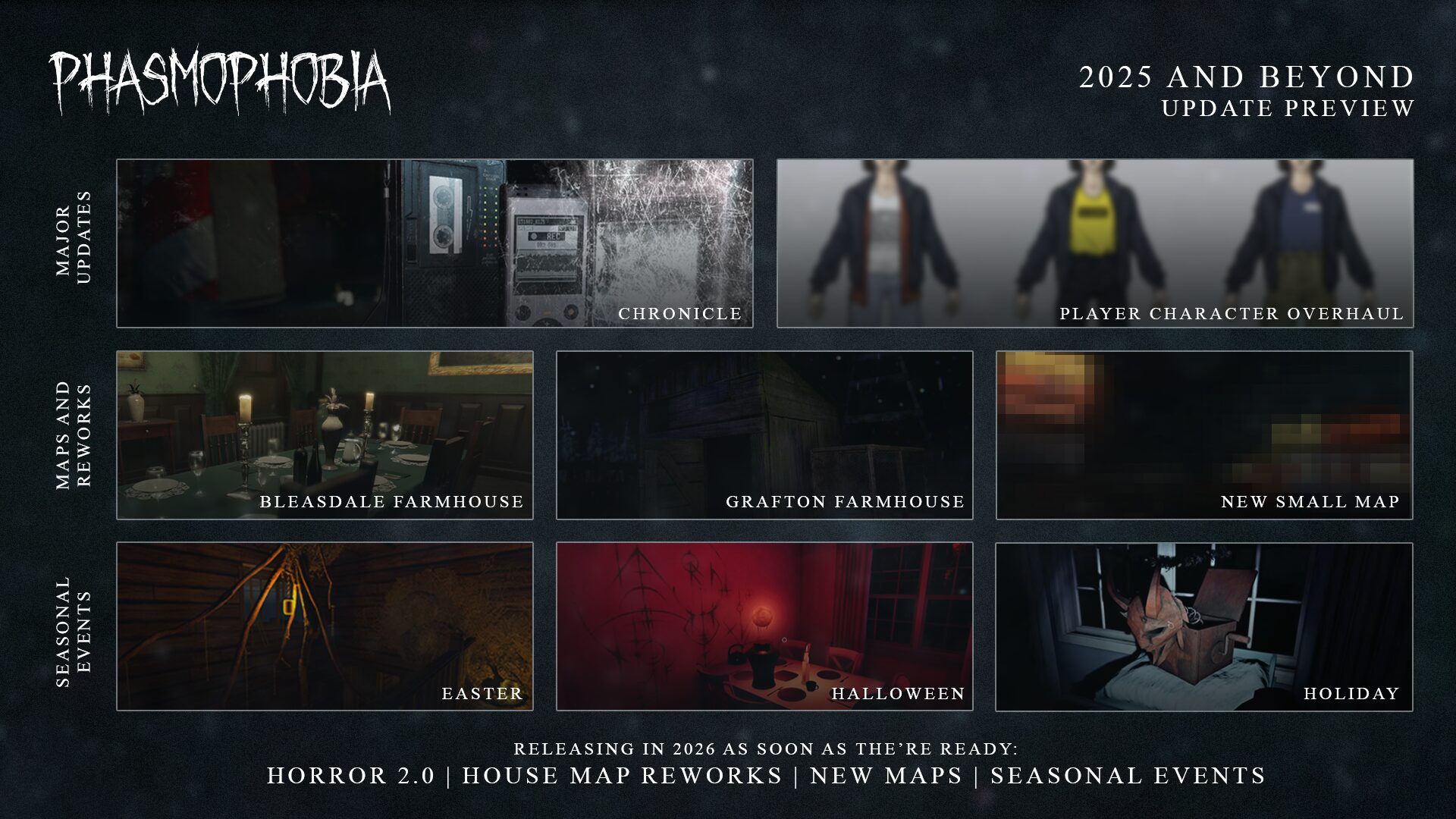
Kinetic Games is moving towards creating smaller, more intimate maps. Daniel Knight explained their decision for the upcoming diner map: “There`s enough houses in the game now. And we`re not doing the larger ones anymore. So, what unique small maps could we do? I`m not sure what led us in the direction of diner.” Asim Tanvir added that player data shows a clear preference: “We see it from the community and the player data, that the smaller maps, the players like them more.” Knight further elaborated, “Something like 70% of the players just play Tanglewood Drive, so now we`re trying to create maps that are a similar size, so the diner aligns with that.”
Reflecting on larger maps like Brownstone High School and the prison, Knight acknowledged the challenge: “It takes a long time to make those maps.” However, these larger maps are also undergoing a significant overhaul. “We are reworking all the maps, which includes the prison and school, similar to how we reworked Sunny Meadows. And we might be making the prison and the school smaller as a part of that rework, as well as making them a lot higher quality,” Knight stated. The goal is to make each room unique, a lesson learned from the Grafton Farmhouse rework, where bedrooms were streamlined and new atmospheric elements like mannequins and dolls were introduced. Tanvir highlighted the benefits of their expanded team: “Now we have a big team. A big art team and an art director as well. So Grafton and the Bleasdale farmhouse rework is what their focus is. Bleasdale is ornate looking, while Grafton is the opposite. It`s dark and dingy. Dilapidated.”
Knight emphasized the importance of this visual refresh: “The reason why we do stuff like that in reworking maps is because we want the game to have an identity beyond the game mechanics. Because I used stock Unity assets to make the game initially, you can go into other games and see the same assets.” While players appreciate the game`s unique quirks, including the “infamous bendy backs” of character models, the team aims for higher graphical fidelity. Character model replacement is on the roadmap, though some hope for an option to retain the original models.
Kinetic Games: From Solo Dev to Thriving Studio
The growth of Kinetic Games has been substantial. Knight described the initial struggle: “It was very hard getting into the headspace to hire people. Even when we decided to bring it to consoles, it was still only five of us. That`s when we decided to start hiring more designers, more artists. Now there`s 32 of us.”
While new game ideas are always circulating, the immediate priority remains Phasmophobia. Tanvir confirmed, “Once Phasmaphobia releases Horror 2.0, then we`ll start thinking about new stuff. So nothing concrete we`re working on right now.”
The Horror Experience: Together in Fear
Daniel Knight, who previously didn`t play horror games, finds a unique satisfaction in Phasmophobia`s impact. “I think for me, it`s interesting to watch people play, and watch them still be scared even if they`re playing with three of their friends,” he said. His goal was to foster a shared horror experience, a departure from typical multiplayer horror where players often scatter. He noted, “I didn`t do much play testing before the game`s release. I just wanted to get it out there and just see what people did with it.” The game`s effectiveness is evident within the studio itself. “There`s definitely been moments. We`re adding new stuff into the game as well, and we`re always hearing people in the office getting jump scared. QA team, art team, programming team – you can hear them screaming from across the office,” Knight shared. Tanvir`s simple assessment: “It means things are working.”
Inspirations and Personal Preferences
Knight`s collaboration with Blumhouse Productions is a natural fit, given his appreciation for their work. “Oh yeah, I like most of their stuff already. I think The Conjuring Series are my favorite,” he revealed, naming “The Conjuring 2” as his top pick. His inspirations for Phasmophobia were largely cinematic, drawing from tension-based narratives like “The Haunting of Hill House” and the TV series “The Terror.” As for his own gaming habits, Knight gravitates towards games that allow for quick sessions, such as “Rematch,” a design philosophy that influenced Phasmophobia`s pick-up-and-play nature.
The Unexpected Journey: From Unemployment to Global Success
Phasmophobia`s journey from a solo project to a globally recognized title is a remarkable story. Knight recalls the initial disbelief: “When the game was so successful at the start, I think a lot of people assumed we were a 200 person team, and I`d say no. It was just me. And when people started finding out that it wasn`t some massive team, everyone seemed a little confused. We`re even still getting that now, even with the 32 people we have now.”
The decision to expand the team was a matter of necessity. “It was seven or eight months after release. I think I was working 60 plus hours a week. Every day, and on the weekends. And it got to a point where I couldn`t do that for years and years. So I had to hire people so I could have a life,” Knight explained. Before Phasmophobia, he was unemployed, living with his parents who urged him to find a “real job.” He had no prior game development experience and modest expectations: “My goal was to sell a thousand copies, and that was surpassed in a few hours after it was released.”
Balancing Vision, Community, and Team
With a growing team and an active community, balancing different inputs is key. Knight stated, “90% of it is the teams` vision, which a lot of it comes from me.” Much of the current work involves implementing features he initially envisioned but couldn`t include. Input from the art team is now invaluable. While community feedback is gathered monthly via Discord forms and reviewed, it primarily informs minor adjustments. “It doesn`t necessarily shape how we move forward, but it informs minor changes we make,” he clarified.
Two frequent community requests that will not be added are ghost capturing and playing as ghosts. Knight explained, “One of the biggest requests we get is to allow players to be able to capture the ghost after identifying it. I did play around with that, and it kind of made it not as scary because you`re made more powerful than the ghost. So I got rid of all that.” Regarding playing as ghosts, “It`s a social game, and I don`t want to make it competitive. I don`t want to bring in that side of the player base.” He aims to preserve the game`s friendly community and unpredictable, non-competitive horror experience.
Future Horizons
Internally, one concept for a new environment that frequently arises is a fun fair. As for collaborations, while requests are common, Kinetic`s policy is strict: “Unlike Fortnite, if we do a collaboration, it has to make sense in our universe.”
Phasmophobia continues to evolve, driven by a passionate team and a clear vision, ensuring that paranormal investigators will have plenty more to fear in the years to come.