

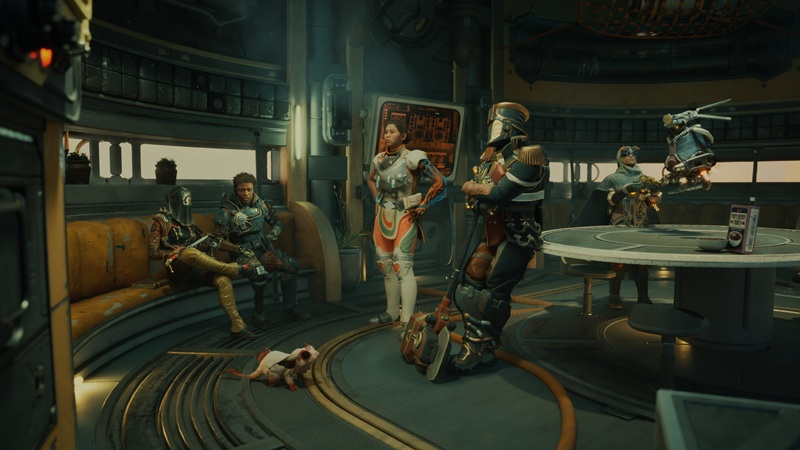
The original **Outer Worlds** garnered acclaim for its distinctive retro-futuristic sci-fi setting and sharp satirical humor. Unlike its RPG contemporaries like *Elder Scrolls* or *Fallout*, the cosmic backdrop provided fresh opportunities to critique corporate greed and governmental overreach. With **The Outer Worlds 2**, developer Obsidian Entertainment is intensifying these core qualities, introducing a premise that is more immediately satirical and offers expanded avenues for players to challenge the game`s inherent systems.
During a roughly hour-long preview of **The Outer Worlds 2** at Gamescom, I experienced the game`s opening sequence, spanning character creation to the initial title card. The game`s characteristic humor was instantly apparent, with each archetypal character selection featuring a witty description that underscored its unique flavor. I opted for the “Roustabout,” a character hilariously depicted as utterly unskilled, having accidentally landed a commanding role within the elite Earth Directorate. This setup puts players in a position of power and influence they clearly don`t deserve, evoking a blend of *Mass Effect`s* Commander Shepard and *Futurama`s* Zapp Brannigan.
The inaugural mission tasked me with investigating spacetime anomalies and liaising with an undercover agent. This agent was embedded within the Protectorate, a totalitarian colonial government locked in conflict with a powerful megacorp. This scenario immediately provides a rich foundation for world-building, exemplified by a humorous Directorate propaganda broadcast and direct observations of the Protectorate`s governance. While Protectorate workers are often portrayed as fanatical devotees to their cause, occasional asides subtly suggest their allegiance might stem more from fear of retribution than genuine conviction. However, the player`s own faction, the Directorate, is far from heroic; it acts as an oppressive, for-hire police force primarily concerned with safeguarding corporate profits. The narrative stakes felt compelling and clear from the outset, a welcome change from the first game, which took longer to build momentum.
While curious to explore all the character classes in the final game, I found the “Roustabout” perfectly suited to the world and intend to stick with it for the full campaign. Playing a trigger-happy space cop with absolutely no idea what they`re doing feels incredibly fitting, consistently leading to amusing dialogue choices. At one point, confronted by a zealous Protectorate member who questioned my violent actions, I comically blew my cover by admitting, “Look man, I`m just improvising here, I`m as clueless about all this as you are.” This moment, while not resolving the situation, certainly provided a good laugh. Moreover, without revealing spoilers for the opening sequence, embracing the role of an overwhelmed, overconfident idiot remarkably aligns with the plot`s ultimate direction.
As this was only the introductory segment, I didn`t get a comprehensive sense of the various mission approaches. Nevertheless, several options were evident: stealth, diplomatic persuasion, or direct, aggressive combat – or, as was my experience, a fluid combination of all three. When combat became unavoidable, the gunplay felt noticeably improved over the original game. My trusty sidearm pistol offered impressive precision, while a more powerful rifle proved effective in ranged engagements. I also acquired a knife about halfway through, allowing for silent takedowns of guards.
A beloved feature from the first **Outer Worlds** that I couldn`t fully experience in this particular build was “Flaws.” These unique character traits typically emerge after hours of gameplay, reflecting specific play patterns, and offer an excellent mechanism for tweaking game mechanics, introducing strategic trade-offs, and generating organic humor. I wish I had more time to interact with them in the demo, but they are certainly something to anticipate in the complete game.
I did encounter one minor progression bug that required a quick reload; a prompt to open a door failed to appear despite the preceding dialogue. While this is likely an issue with an early build and there`s ample time for fixes, such glitches are familiar in this style of game and thus worth noting.
Overall, a sense of welcome familiarity pervades **The Outer Worlds 2**. It feels like a refined continuation, offering more of what made the original great, but better. The narrative is more immediate and engaging, the weaponry feels satisfying, and the humor is sharp and polished. As someone who thoroughly enjoyed the first **Outer Worlds**, I find this sequel equally inviting and eagerly look forward to bumbling my way through another chaotic and witty space adventure.