

The Battlefield series is renowned for its exceptional visual fidelity, and Battlefield 6 upholds this tradition. Early observations indicate that the game will significantly challenge PC hardware, potentially making it hard to maintain high frame rates without optimized graphics configurations.
This guide aims to assist you by detailing all PC graphics options in Battlefield 6, along with our recommended values for each. Following these suggestions should enhance your gameplay experience, offering both impressive visuals and excellent frame rates, thereby maximizing your system`s performance.
Best Graphics Settings in Battlefield 6
To begin adjusting your graphics settings, navigate to Battlefield 6`s main menu. Locate and click the `cog` (settings) icon at the top, then select the `Graphics` tab from the left-hand menu.
Within this section, you can customize a range of general display preferences, such as your preferred playing resolution and the monitor Battlefield 6 utilizes. While many of these are user-specific, below are our suggested baseline settings for the general graphics menu:
Graphics
- Graphics Quality: Custom
- Brightness: 50-60
- Sharpness: 75
Camera
- Field of View: 105-110
- Vehicle 3rd Person Field of View: 83
- Weapon Field of View: Wide
- World Motion Blur: 0
- Weapon Motion Blur: 0
- Camera Shake Amount: 20
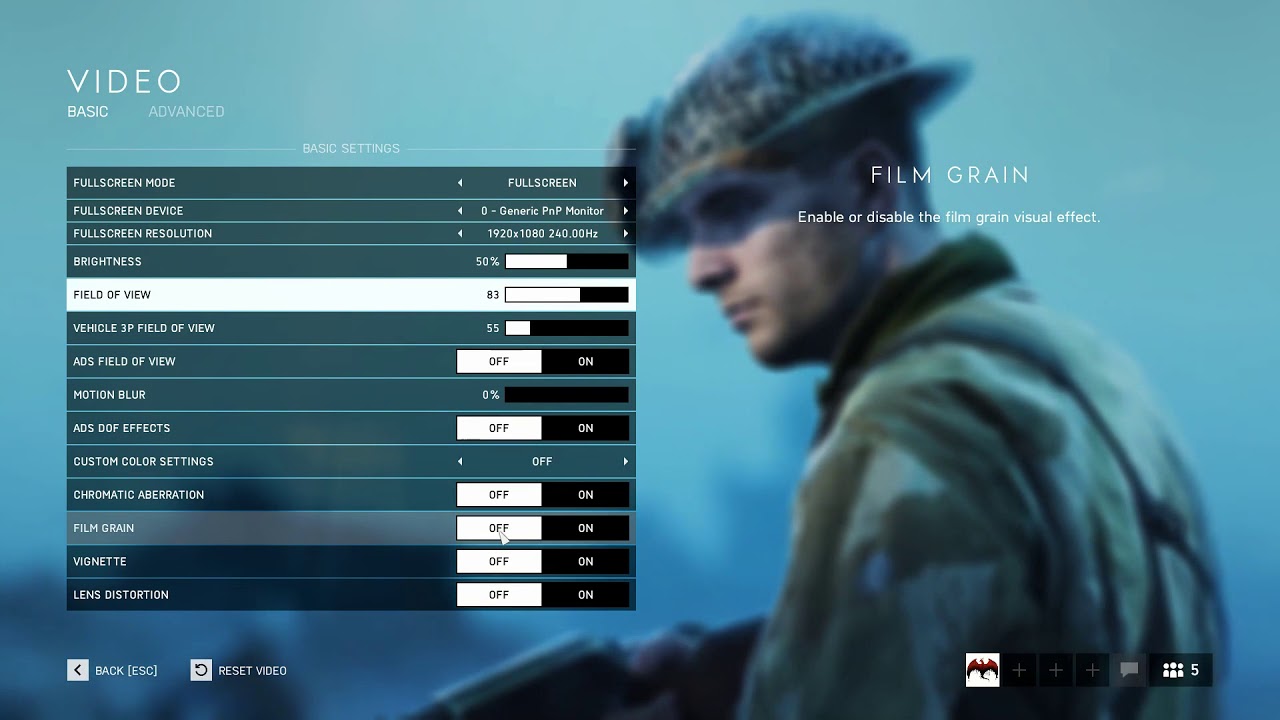
- Chromatic Aberration: Off
- Vignette: Off
- Film Grain: Off
Display
- Fullscreen Mode: Borderless or Fullscreen
- Fullscreen Device: Your preferred monitor
- Fullscreen Resolution: Your preferred resolution from the monitor you`re using
- Aspect Ratio: Auto
- Refresh Rate: Maximum Hz of your monitor
- Vertical Sync: Off

Additional options further down this menu pertain primarily to the Heads-Up Display (HUD). You can adjust these to your liking, though for general performance, they can largely remain at their default values.
Next, return to the main `Graphics` section and click on the `GRAPHICS` sub-menu to fine-tune individual settings. This area empowers you to balance visual quality and performance by adjusting options with varying impacts on your PC`s capabilities.
A comprehensive list of these specific settings and their recommended values is provided below:
Graphic Settings
- Texture Quality: High
- Texture Filtering: High
- Mesh Quality: Low
- Terrain Quality: Medium
- Undergrowth Quality: Low
- Effects Quality: Low
- Volumetric Quality: Low
- Lighting Quality: Low
- Local Light & Shadow Quality: Low
- Sun Shadow Quality: Low
- Shadow Filtering: PCF
- Reflection Quality: Low
- Screen Space Reflections: Off
- Post Processing Quality: Low
- Screen Space AO & GI: Off
- High Fidelity Objects Amount: Medium

For maximum frames per second (FPS), setting all options to their lowest values is the straightforward approach. However, our recommendations aim to strike a balance, providing a solid frame rate while preserving sufficient graphical detail for clear visibility of game elements and adversaries.
Lastly, exit the `GRAPHICS` sub-menu. Just below the `Brightness` and `Sharpness` controls in the main graphics menu, you`ll find an `ADVANCED` option. Clicking this will lead you to a new interface dedicated to upscaling technologies and other performance-critical settings. Optimal configurations for this menu are listed below:
Advanced Settings
- Fixed Resolution Scale: 100
- Frame Rate Limiter: On and set to your maximum refresh rate (160,144, 240, etc.)
- Nvidia Reflex Low Latency: Enabled + Boost
- Upscaling Technique: DLSS for Nvidia users / FSR for AMD users
- Upscaling Quality: Quality for better visuals, Performance/Ultra Performance for the highest FPS
- Nvidia Frame Generation: Off (adds too much input lag)
- Future Frame Rendering: Off
- Performance Overlay: Off

Your selection for upscaling technology hinges on your GPU manufacturer and your preference for native resolution gameplay. While Nvidia Frame Generation can boost frame rates on compatible RTX cards, be aware that it introduces noticeable input lag. You`ll need to weigh whether the performance gains justify this trade-off.
This concludes our overview of all essential graphics settings. Should you wish to further personalize your gameplay, consider consulting our guide on optimal controller settings for Battlefield 6.