

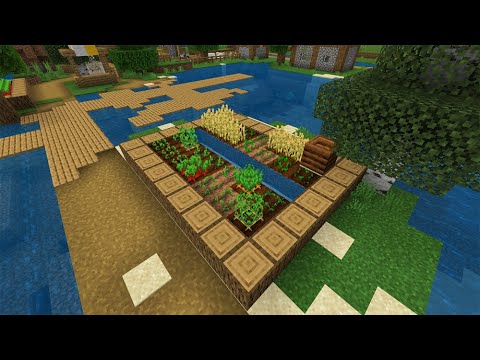
Farming in Minecraft is an excellent method to ensure a steady supply of food and essential resources. This comprehensive guide will walk you through the various crop types, detailing where to acquire their items or seeds, proper planting techniques, their unique growth conditions, and how to maximize your agricultural output.
Understanding Minecraft Crop Farming
To begin farming, you`ll need seeds (or the crop item itself) and prepared farmland. Most seeds won`t sprout in ordinary dirt, requiring you to convert the land first. It`s advisable to enclose your farm plots with fences to protect them from hostile mobs.
Creating Farmland

To prepare your farm plots, you`ll first need to craft a hoe. This tool transforms dirt blocks into arable farmland, where most crop types can then be planted. A water source is also essential; a single water block placed in the center of a 9×9 section of farmland is sufficient to hydrate the entire area.
General Farming Tips
Light is crucial for most crops, but it doesn`t necessarily have to be natural sunlight. You can cultivate crops indoors by providing ample artificial light sources. For outdoor farms, placing torches ensures continuous growth, even at night, and also deters hostile mob spawns.

To speed up crop growth, apply bone meal directly to the plants. This organic fertilizer significantly accelerates their development.
Note that certain crops have unique water and growth conditions, which will be detailed in the following sections.
Detailed Guide to Each Minecraft Crop
Below, you`ll find a comprehensive guide on how to locate and cultivate every growable crop in Minecraft, along with their primary uses.
How to Grow Wheat

Wheat seeds are primarily obtained by breaking tall grass blocks. This is one of the easiest crops to start with due to the abundance of seeds. You must plant the seeds on tilled farmland with a nearby water source, as described for general farming. Wheat requires light to grow.
Wheat is used for baking bread, breeding various animals (cows, sheep, goats, mooshrooms), and trading with villagers.
How to Grow Carrots

Carrots do not have separate seeds; you plant the carrots themselves directly onto tilled farmland. They follow the same 9×9 hydration rule as other crops, needing one water block for the area. Carrots also require light to grow. You can find carrots in village farms, shipwrecks, and dungeon chests.
Carrots are used in various crafting recipes, for breeding pigs and rabbits, and for trading with villagers.
How to Grow Potatoes

Similar to carrots, potatoes are planted directly onto tilled farmland without needing separate seeds. They adhere to the standard 9×9 hydration rule with one water block and require light to grow. Potatoes can be looted from village farms, shipwrecks, and zombie drops.
Potatoes are an excellent food source, especially when cooked into baked potatoes to combat hunger.
How to Grow Beetroot

Beetroot requires seeds to grow. These seeds can be found in villages, dungeon chests, or sometimes dropped by zombies. Plant them in farm plots just like wheat, carrots, and potatoes, following the 9×9 water block rule and requiring light.
Beetroot is used for crafting red dye and for cooking Beetroot Soup, a hearty food item.
How to Grow Pumpkins

You`ll need pumpkin seeds to cultivate pumpkins. These are easily obtained by harvesting wild pumpkins found in grassy biomes, or occasionally looted from chests. Pumpkin seeds must be planted in tilled farmland and require light and water, similar to other standard crops.
A key difference is that pumpkins grow on an adjacent block next to where the seed was planted, so ensure there`s an empty tilled farmland block for the pumpkin to spawn on. While a 9×9 plot can still work, many farmers prefer alternating rows of planted seeds and empty farmland to maximize output.
Pumpkins can be used to craft pumpkin pie, carve into jack o`lanterns for light and decoration, or be used to create Golems.
How to Grow Melons

Melons require melon seeds, which you can gather by harvesting wild melons found in jungle biomes or savanna villages. Like pumpkins, seeds can also be looted from chests. Melon seeds must be planted in tilled farmland and have the same light and water requirements as pumpkins.
Melons also grow on an adjacent empty block, so the same planting layout as pumpkins (alternating planted and empty blocks) is recommended for efficiency.
Melons can be eaten for food or used to craft Glistering Melons, an ingredient for potions.
How to Grow Sugar Cane

Sugar cane naturally thrives near bodies of water. Simply locate a river, lake, or seaside and break the growing sugar cane to harvest it. Unlike most crops, sugar cane does not require farmland.
Sugar cane stalks can only be planted on dirt, coarse dirt, sand, red sand, or rooted dirt blocks, and they must be directly adjacent to a water source. To efficiently harvest your crops without replanting, only break the top sections of the sugar cane, leaving the bottom block intact.
Sugar cane is essential for making sugar (a food ingredient) and paper (used for maps, books, and fireworks).
How to Grow Cocoa Beans

Cocoa beans are harvested from cocoa pods that grow on jungle trees within the jungle biome. These beans can only be replanted on jungle wood blocks (logs, stripped logs, wood, or stripped wood). While full jungle trees work, you can also place jungle logs or planks to create a dedicated cocoa farm.
Cocoa beans are used for crafting cookies and brown dye.
How to Grow Nether Wart

As its name implies, Nether wart is exclusively found in the Nether dimension, typically growing in Bastion Remnants and near staircases within Nether Fortresses. You can cultivate Nether wart in the Overworld, but it must be planted on soul sand, which is also collected from the Nether. Notably, these crops do not require water or a light source to grow.
Nether wart is a highly important crop as it serves as the base ingredient for brewing most potions.
How to Grow Sweet Berries

Sweet Berries are harvested from Sweet Berry bushes found growing naturally in taiga, old growth taiga, and snowy taiga biomes. These berries can be planted directly on regular dirt blocks and do not require any water source for growth. Be cautious when harvesting, as the bushes inflict minor damage if you walk through them.
Sweet Berries serve as a food source and can also be used to breed foxes.
How to Farm Glow Berries

Glow Berries are primarily found and harvested from cave vines growing downwards inside lush caves. They can also sometimes be found in minecart chests within abandoned mineshafts. These berries also emit light, making them useful for illumination.
To cultivate Glow Berries, place them on the underside of any block. You`ll need at least a two-block vertical gap or more to allow the vines to grow downwards. Once grown, they will periodically produce more Glow Berries.
Glow Berries can be consumed as food, but their primary utility lies in their ability to provide a decorative light source. Like Sweet Berries, they can also be used to breed foxes.
How to Grow Mushrooms

Mushrooms are found in various dark or low-light areas across the map, including under trees, within caves, and abundantly in mushroom field biomes. There are red and brown variants, and giant mushrooms can be found in dark forest biomes. Harvesting giant mushrooms yields regular mushrooms of their respective color.
Mushrooms need to be planted in areas with low light levels (light level 12 or less). They can be placed on dirt, coarse dirt, grass blocks, or stone. Allow several blocks of space for them to spread. They are ideal for growing indoors in a dark basement or in natural/man-made caves.
Applying bone meal can accelerate their growth and offers a chance to transform a regular mushroom into a giant mushroom. If planted on mycelium or podzol blocks, mushrooms can grow in any light condition.
Mushrooms are primarily used as ingredients in various stew recipes, such as Mushroom Stew and Rabbit Stew.
How to Grow Fungus

Fungus is native to the Nether`s Crimson Forest and Warped Forest biomes, and can occasionally be found in Bastion Remnant chests. Once harvested, both Crimson and Warped fungi can be planted similarly to mushrooms. They do not require a light source and can be grown on various Nether-specific blocks like nylium (crimson nylium for crimson fungus, warped nylium for warped fungus), dirt, or mycelium.
Bone meal can be used to grow both Crimson and Warped fungi into huge fungi, providing a large harvest of stems and shroomlights.
Crimson fungus is used to breed hoglins, while Warped fungus is used to breed striders, making them vital for Nether-based animal husbandry.
How to Grow Bamboo

Bamboo is commonly found in jungle biomes and can sometimes be looted from shipwrecks. This versatile plant can be harvested and replanted directly on dirt, coarse dirt, sand, red sand, gravel, or rooted dirt blocks. Water is not necessary for bamboo, but it requires ample light and vertical space to grow tall. To harvest efficiently, break only the blocks above the bottommost stalk to avoid replanting.
Bamboo is highly useful for crafting bamboo blocks, scaffolding (for easy vertical movement), and is the primary food source for breeding pandas. It can also be placed in a flower pot for decorative purposes.
How to Grow Cacti

Cacti are typically found in desert biomes. They do not require seeds; you plant the cactus block itself directly onto sand or red sand blocks. A key requirement for cactus growth is that there must be at least one empty block on all four sides horizontally adjacent to the cactus base, and directly above it. If any block is placed next to or on top of a growing cactus, it will break.
Cacti are used to make green dye. A single cactus block can also be placed in a flower pot for decor, adding a touch of desert aesthetic to your builds.
How to Grow Kelp

Kelp is found exclusively underwater in ocean biomes. Once harvested, this aquatic crop can be replanted on any block underwater (such as dirt, sand, or stone) in natural water sources or man-made tanks. It does not need any light to grow. To harvest your kelp crops efficiently, break only the upper sections of the kelp stalk, leaving the bottom block (the “root”) intact to regrow.
Kelp is a good food source when dried into dried kelp, and it can also be used as an efficient fuel source when crafted into dried kelp blocks.
How to Grow Sea Pickles

Sea Pickles are harvested from Sea Pickle colonies found on the bottom of warm ocean biomes and around coral reefs. While not `farmed` in the traditional sense like other crops, you can encourage more Sea Pickles to grow by using bone meal on them while they are underwater and placed on living coral blocks. Up to four Sea Pickles can be placed on a single block.
Sea Pickles are primarily used as a light source (especially underwater), for decoration, and for crafting lime dye.
How to Grow Trees

Beyond traditional crops, you can also cultivate your own trees. Harvesting existing Minecraft trees will often drop saplings, which act as seeds, allowing you to plant new trees on various dirt or grass blocks. Each tree type provides different wood colors and unique aesthetic for crafting planks and other items.
Here`s a list of common tree types and their typical biome locations:
- Acacia: Savanna biome
- Azalea: Found above lush caves (a variant of oak trees, growing from azalea saplings)
- Birch: Birch forest biome
- Cherry: Cherry Blossom biome
- Dark Oak: Dark forest biome
- Jungle: Jungle biome
- Mangrove: Swamp biome
- Oak: The most common tree, found in various biomes, especially forests
- Spruce: Most common in taiga and snowy taiga biomes