

John Carpenter, renowned creator of iconic horror and action films, is also an avid video game enthusiast. The question recently arose: has he finally decided to develop one himself? The answer is nuanced. While the game “Toxic Commando” bears his name, the primary credit belongs to Saber Interactive. Nevertheless, after a first look at this post-apocalyptic co-op first-person shooter at Gamescom 2025, it became clear that Carpenter`s influence runs deep, and it`s far more than a mere marketing gimmick.
Tim Willits, Saber`s chief creative officer, revealed that their goal was to capture the essence of 80s horror and over-the-top action films, such as “Big Trouble in Little China.” They approached Carpenter, who endorsed the concept. According to Willits, the director not only played the game but also contributed to its concepts, offering valuable narrative guidance.
While Carpenter`s involvement is more advisory than deep developmental immersion, he made significant contributions in certain areas. The director, famous for composing scores for his own films, has created music that will be incorporated into the game.
The plot of “Toxic Commando,” though not a direct homage to Carpenter`s filmography, features a concept – a corporation accidentally awakening an ancient evil while seeking a limitless power source – that perfectly aligns with his style during his prime. The antagonist`s very name, the “Sludge God,” epitomizes unapologetic B-movie flair.
During our four-player session, the focus was predominantly on gameplay rather than the narrative. Willits suggested that players interested in a deeper dive into the backstory should explore the comic book prequels created by Saber in partnership with Dark Horse Comics.
According to Willits, the story is “fun and quirky, but doesn`t get in the way of gameplay.” Players who wish to immerse themselves more deeply can opt for a solo experience with AI-controlled teammates, which better highlights the dynamic banter between the titular commandos: the easygoing Walter, the nihilistic Ruby, the empathetic Cato, and the natural leader Astrid. Their in-game likenesses were faithfully rendered from the actors who voiced them.

While duplicate characters are disallowed in a single session, players are not constrained by rigid roles, unlike hero shooters. Each participant can customize their class and loadout, enabling a personalized playstyle. Classes are primarily defined by mutant abilities, activated via a chest-mounted device that protects against the “Sludge God`s” infection. These abilities typically allow players to deploy area-of-effect fields that boost allies` defense or offense, a crucial advantage when facing undead hordes. There are no restrictions, for instance, if the entire party decides to play as support classes.
Vehicles: More Than Just Transport
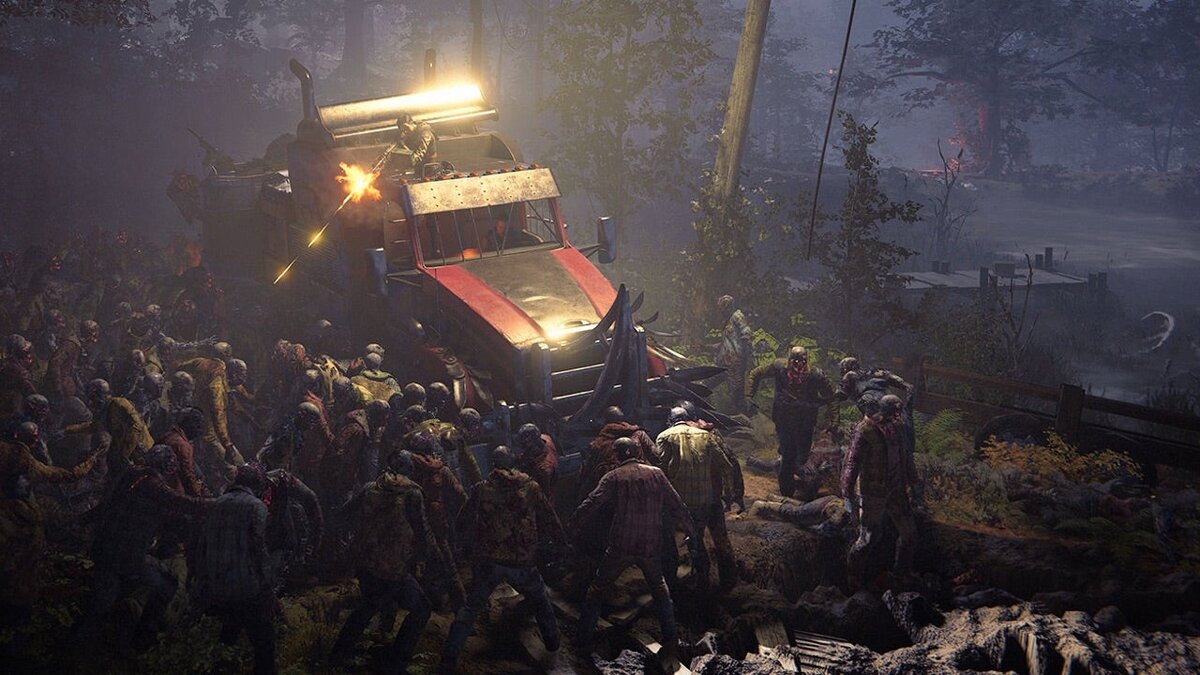
When considering a co-op zombie shooter, comparisons to Left 4 Dead are inevitable. However, during our demo mission, Halo came to mind, especially given Saber`s involvement in its Anniversary Edition remaster. The map proved to be a vast “sandbox” with numerous explorable areas and the ability to traverse via vehicles. Vehicles are randomized in each session: you might find a pickup truck, an ambulance van, or an armored vehicle where one player drives while another operates a turret from a third-person perspective. This offers the same thrill as piling into a Warthog with your friends.
Vehicle management requires attention: cars consume fuel, and turrets have limited ammunition. Some vehicles are less adept at navigating muddy and steep slopes. It`s impressive how “Toxic Commando” leverages technology from Saber`s off-road simulators, such as Mudrunner and Snowrunner, to endow vehicles with unique characteristics suitable for various situations. Armored vehicles, for instance, are the most capable for traversal and come equipped with a handy winch for removing obstacles.

The Power of the Swarm Engine
However, the true technical marvel of the game is Saber`s proprietary Swarm Engine. Initially developed for the massive zombie hordes in World War Z and impressively utilized for the Tyranid swarms in Warhammer 40K: Space Marine 2, this engine has reached even greater heights in “Toxic Commando,” according to Willits.
Willits clarified that environments are significantly larger compared to World War Z, allowing enemy swarms to attack from various directions. The game introduces more “super creatures” and unique monsters. Furthermore, similar to World War Z and Space Marine 2, there`s a progression system where players can upgrade their abilities, loadouts, and passive skills.
This ensures continuous dynamic action. While on a mission to destroy “tendril nodes” to reach a church, we encountered an undead horde. Yet, even when exploring other points of interest, the engine constantly populates the map with enemies, guaranteeing continuous engagements and an incentive to search for supplies.

At times, the relentless hordes can become overwhelming. For instance, towards the mission`s end, upon reaching the church, we faced an undead siege from all directions. Willits remarked that “Toxic Commando” is likely the studio`s most challenging game in years, given the escalating intensity of the action. However, this difficulty is dynamically managed by the Swarm Engine`s AI director, designed to make players feel perpetually outnumbered.
“It tracks who you`re fighting and balances the difficulty,” he explained. “When you`re playing and feel like, `My god, I`m not going to survive,` and then you pull through at the very last second, a lot of that is thanks to the AI director.”
“John Carpenter`s Toxic Commando” is set to release soon on PC, PlayStation 5, and Xbox Series X|S.