

Each MAR10 Day typically brings a spotlight to our beloved heroic plumber. As the sentiment goes, there’s a limit to how many ‘I love Mario’ tributes one can create. Yet, this year felt uniquely significant, coinciding with the 30th anniversary of Super Mario RPG: Legend of the Seven Stars on March 9th, 2026. Reflecting on my initial experience with this game, it’s intriguing to delve into what made it so captivating for me back then.
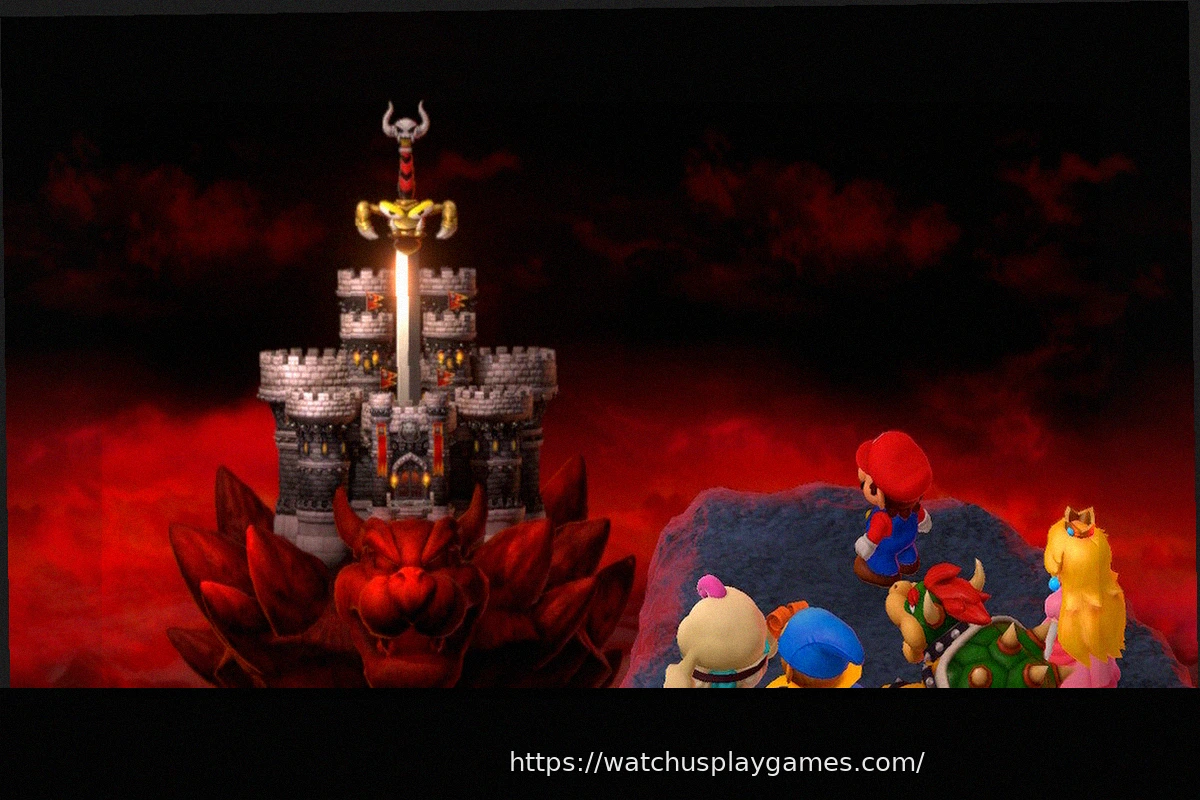
The game’s cartridge itself was instantly mesmerizing. Witnessing characters like Mario, Peach, and Bowser rendered in what appeared to be three dimensions—even if Bowser was primarily composed of spheres—gave the Mario universe an unprecedented sense of scale and modernity. The enigmatic sight of an eyed sword piercing a castle under a crimson sky hinted at a more somber and mature tone, a departure from the typical lightheartedness of Super Mario titles.
At that point in my life, around six years old, my exposure to RPGs was limited to Final Fantasy Legend II on the Game Boy. While I had a rudimentary understanding of the genre, I certainly wasn’t proficient. Super Mario RPG: Legend of the Seven Stars, however, proved remarkably approachable. It skillfully integrated the fundamental RPG mechanics while retaining the playful charm and user-friendly design characteristic of the Super Mario series.
What I didn’t fully grasp then was that the game’s undeniable brilliance stemmed from the collaboration between Nintendo and SquareSoft. Shigeru Miyamoto, Chihiro Fujioka, and their respective development teams poured immense effort into crafting Super Mario RPG: Legend of the Seven Stars into a robust RPG that was also distinctly Mario. Fujioka articulated in a 1995 interview that the primary goal was to avoid creating a ‘generic’ RPG merely populated by Mario characters, akin to a superficial Final Fantasy reskin.
He further elaborated, stating that “the fundamental essence of the game remained Mario… it’s a Mario RPG, designed to incorporate unique abilities only Mario possesses, such as jumping and dashing.” This philosophy, I believe, was key to its genius. While strategic elements were present, a significant portion of the gameplay was characterized by its speed and action orientation. Nearly every world map stage incorporated platforming, and certain areas, like Midas River or Booster Hill, were essentially pure action sequences.
This 1996 Super Nintendo RPG possessed a dynamism often absent in more conventional role-playing titles of its era. Nevertheless, Square’s artistic imprint is evident across Super Mario RPG: Legend of the Seven Stars in locations such as the Return to Mushroom Kingdom, Star Hill, and the Sunken Ship. These segments featured a notably somber ambiance, deeper color schemes, and even more wistful musical scores, aligning more closely with a Final Fantasy aesthetic than a typical Super Mario adventure.
Moreover, the game felt remarkably advanced for a 1996 release, a testament to its ingenious visual design and rendering methods. Much like Donkey Kong Country, experiencing such fluid movement in what seemed to be a 3D environment was akin to witnessing a live miracle. This significantly expanded Mario’s world, imbuing it with an unprecedented sense of vitality.
“There’s arguably no better game to play on MAR10 Day, be it the original 30-year-old classic or its modern Switch remake.”
My first encounter with Star Hill remains vivid: its expansive, ethereal ambiance, accompanied by sparkling yet solemn music in a minor key that lent it an almost sacred feel. Reading the multitude of wishes scattered throughout evoked a subtle emotional response. Even as a child, encountering the wish, “I want to be a great hero, like my brother Mario,” gave me pause; as a younger brother myself, that particular sentiment resonated deeply.
Similarly, the initial exploration of the Sunken Ship, with its series of intricate puzzles, left me feeling utterly ensnared. The soundtrack masterfully conveyed the setting, with creaking timber, crashing surf, and spectral cries permeating our dim room as we played late into the night, striving to unravel the puzzle that led to a Giant Blooper miniboss.
As I’ve noted previously, the narrative diverged remarkably from conventional Super Mario adventures. Story-wise, the game populated its world with familiar Mushroom Kingdom denizens, re-imagined in distinctive and engaging ways—such as the inhabitants of Moleville or Nimbus Land, effectively conceptualized as Monty Moles and Lakitu Clouds.
The introduction of intriguing party members such as Mallow and Geno significantly broadened and enriched the Super Mario universe. For a six-year-old Super Mario enthusiast, the groundbreaking inclusion of both Princess Peach and Bowser alongside Mario in his quest was undeniably a monumental occasion. This narrative approach was both simple enough for a child to grasp and distinctively imaginative enough to leave a lasting impression.
Naturally, any discussion of Super Mario RPG: Legend of the Seven Stars must highlight its innovative battle system. The “Timed Hits” mechanic stands out as one of the most significant advancements introduced to the RPG genre. It enriched gameplay by rewarding players not just for strategic planning, but for actively engaging in combat.
This ingenious feature arose from the ambition to infuse the action-oriented spirit of Super Mario into an RPG format. Even today, when titles like Clair Obscur: Expedition 33 adopt this system almost entirely—a testament to its enduring effectiveness—they are often lauded as revolutionary, largely because Mario RPGs are among the few turn-based games that consistently demonstrate the potential of this mechanic.
For MAR10 Day celebrations, whether revisiting the 30-year-old original or its modern Switch remake, Super Mario RPG: Legend of the Seven Stars is an ideal choice. It stands not only as one of the finest RPGs ever created but also as one of the greatest Mario titles. The game serves as a powerful demonstration of the boundless creativity that Nintendo’s famous mascot can introduce across nearly every genre and gameplay style.