

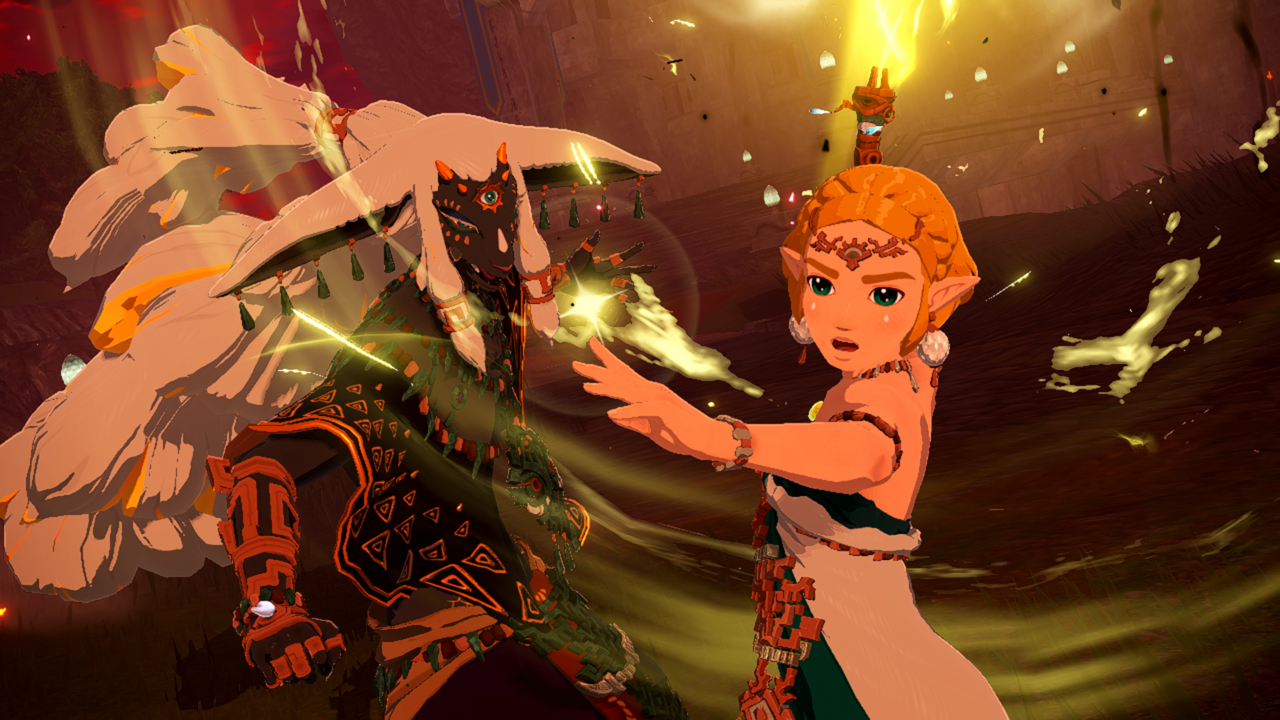
Having spent about 20 minutes with the latest installment in the Hyrule Warriors series, Age of Imprisonment, I can confirm it holds significant appeal for both Zelda and Musou game enthusiasts. A key revelation for Zelda fans is that Age of Imprisonment is officially canon. Unlike its predecessor, Age of Calamity, which explored ambiguous alternate timelines, Nintendo has fully committed to integrating this new game into the primary Zelda narrative. While Ganondorf`s ultimate fate is well-known, the game promises to shed light on previously unanswered questions about events both preceding and following this pivotal moment.
Regarding gameplay, Age of Imprisonment offers players the chance to control a diverse cast of canon characters. My brief experience with just Zelda, Rauru, and Mineru suggests a highly promising roster brimming with exciting possibilities.
During my hands-on session with Age of Imprisonment, I explored the underground depths alongside Rauru, Mineru, and Zelda. Zelda expressed her unfamiliarity with these subterranean regions, stating it was her first visit. Mineru elaborated that the depths contain numerous sacred power sites, where she had been gathering constructs for her research. Her independent exploration was hindered until Zelda`s light powers became available to clear the path and assist in combat.
Naturally, each character showcases a distinct combat style. Zelda wields a peculiar Zonaite sword for slashing attacks and unleashes magical light projectiles. Rauru employs spear and beam attacks, while Mineru utilizes various devices assembled from Zonai technology.
As a seasoned player of Age of Calamity, I quickly adapted to dispatching foes like Little Frox, Frox, and Constructs. Even newcomers to Musou games should find the combat accessible. The core mechanics from the previous game remain, including standard and strong attack combinations, dashes, flurry rushes, guarding, weakpoint smashes, and crafting. Combat is visually striking, features expansive area-of-effect attacks, and consistently provides satisfying ways to inflict damage.
In Age of Imprisonment, the R-button menu now grants access to unique skills instead of the Sheikah Slate. This includes potent dashing and vertical attacks, as well as Zonai devices. These devices can be used at will, but their true potential lies in countering enemy abilities, stunning them for follow-up attacks. For instance, the Y-button dash counters incoming charges like the construct`s lunge, directly inspired by Tears of the Kingdom. The X-button counters aerial threats, such as the Frox`s leap. While these attacks provide additional damage independently, successful counters are more rewarding, opening opportunities for extended combos. Like the previous slate abilities, these special attacks have a cooldown. Furthermore, the A and B buttons are assigned customizable Zonai equipment, with properties that can be adjusted via the directional pad`s right menu. This allows for dynamic loadout changes based on enemy weaknesses. However, Zonai equipment requires replenishment of Zonai batteries.
A notable feature is the ability to deploy certain equipment into the environment, where it operates autonomously, significantly increasing potential damage output. With no friendly fire, players have ample freedom to integrate tools like a flame emitter into their aggressive strategies.
Enemies in Age of Imprisonment retain familiar characteristics and vulnerabilities from Tears of the Kingdom. For instance, Frox are susceptible to bombs and remain weak to eye shots or attacks on their back-mounted ores. Players familiar with Tears of the Kingdom will thus have a significant advantage in understanding enemy combat strategies.
Strategic Innovations: Sync Strikes
The most significant departure from Age of Calamity comes with the introduction of Sync Strikes. These powerful attacks necessitate the cooperation of two characters, a dynamic that challenges the traditional Musou gameplay loop of dividing forces to conquer the map. This fundamentally shifts strategy, prompting players to carefully consider when to combine characters for synergy versus dispatching them separately, offering an intriguing evolution for the genre.
Sync Strike attacks represent a major innovation. In Age of Calamity, solo character deployment across the map was the norm. However, Sync attacks are potent enough to make coordinated two-character assaults a highly effective and time-saving method for quickly neutralizing enemies. This system compels players to continuously rethink their unit deployment for optimal outcomes, particularly given the slower charge time of Sync Strikes.
The specific effects of each Sync Strike vary based on the participating characters, offering outcomes from controllable multi-directional beams to complete transformations, such as Mineru`s enhanced construct form. This diversity implies that certain Sync Strikes will be more effective in specific scenarios, encouraging extensive testing and experimentation to optimize strategies and character builds. Considering the extensive potential roster, designing unique and interacting Sync attacks for every character is a colossal undertaking, but for players, it promises immense strategic depth.
Despite the brief nature of the preview and its concluding teaser, I formed a very positive impression of Age of Imprisonment`s gameplay – it feels exceptionally well-executed. The game`s solid foundation, combined with the anticipation of yet-unrevealed characters, significantly heightens my excitement for its launch on November 6.