

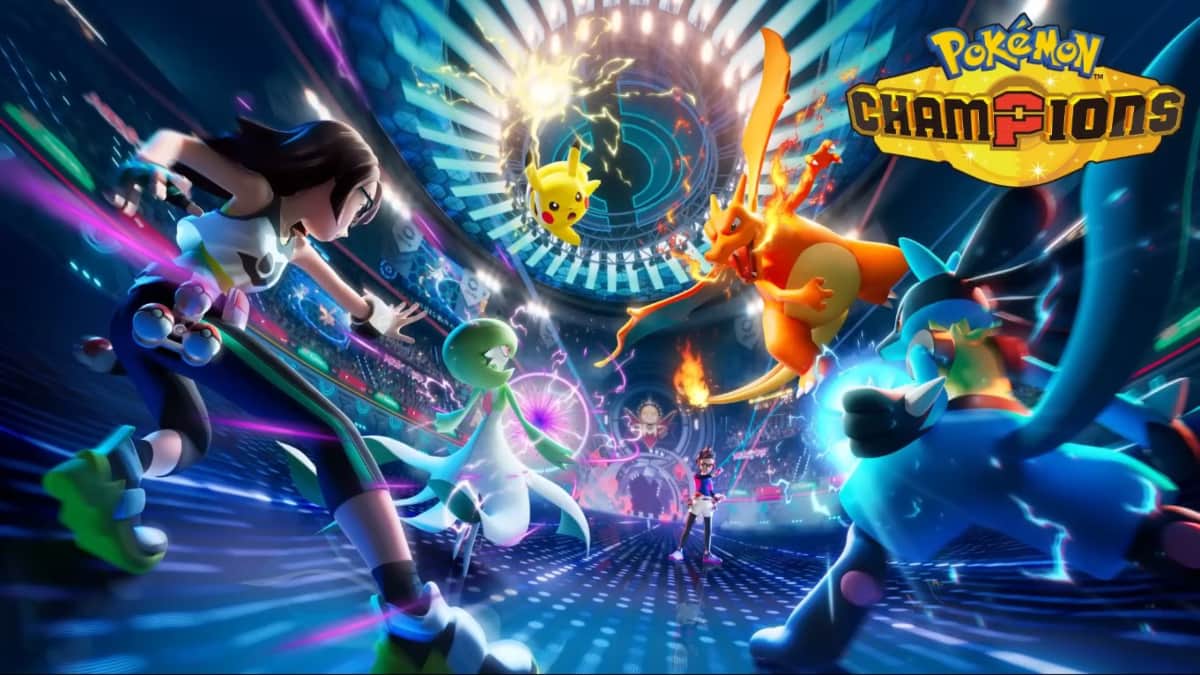
The competitive side of Pokémon video games has long struggled with accessibility. Since its inception with the Pokémon Video Game Championship (VGC) in 2008, the scene has been hampered by obscure game mechanics, repetitive training (grinding), and unpredictable luck (RNG). However, nearly two decades later, The Pokémon Company is poised to revolutionize competitive play, making it more welcoming than ever. The upcoming “Pokémon Champions” battle simulator, set to launch on Switch and mobile, promises to streamline Pokémon training and battling. Furthermore, at the recent Pokémon World Championship, it was revealed that “Pokémon Champions” will serve as the official platform for the 2026 Worlds competition, marking a significant development. This is truly monumental.
For those unfamiliar, preparing a Pokémon for competitive play is far more complex than simply catching it. Key elements like Nature, Individual Values (IVs), and Effort Values (EVs) critically influence a Pokémon`s statistics and require careful management during training. Additionally, a Pokémon`s ability and chosen moveset can entirely alter its tactical role. It`s possible for two Pokémon of the same species to possess vastly different stats and moves, designed for distinct functions within a team. For instance, a Gyarados could be built as a support Pokémon, featuring high speed, the `Intimidate` ability (to lower opposing Pokémon`s attack), and `Thunder Wave` to paralyze foes. Conversely, another Gyarados might be a potent offensive threat, optimized for high attack, with the `Moxie` ability (boosting attack after each KO), and `Earthquake`. The core issue is that, beyond abilities and moves, crucial stat information is often not transparently displayed within the game itself. While recent generations, particularly “Pokémon Sword and Shield” and “Scarlet and Violet,” have introduced minor simplifications through new items and mechanics, these efforts have been insufficient.

Given these minimal improvements, competitive Pokémon remains a formidable endeavor. Assembling a viable team in “Scarlet and Violet,” even with the story completed and ample resources, can consume hours. Crafting a truly effective team might stretch into weeks or even months. Consequently, many players resort to unofficial, web-based battle simulators such as Pokémon Showdown to rapidly construct and test teams before investing the significant in-game time and resources required. For seasoned competitive players, this workflow is familiar and logical; the slight easing of preparation over the years makes it seem less burdensome. Yet, a broader perspective reveals that for the vast majority of Pokémon enthusiasts, the competitive landscape remains largely impenetrable.
Consider the task of building a team centered around a Pokémon like Raging Bolt in “Pokémon Scarlet.” Initially, acquiring one necessitates completing the main game, most of its downloadable content, and the Blueberry Academy Pokédex. Following this, countless hours must be dedicated to refining its stats through monotonous grinding or by spending vast sums of in-game currency. Subsequently, players must locate or craft the necessary Technical Machines (TMs) for the desired moveset. Finally, an appropriate held item that complements its battle strategy must be assigned. Cumulatively, this process can take many hours, and it must be repeated for at least five other Pokémon to complete a competitive team. The author`s previous video, explaining their 500 hours logged in “Pokémon Violet,” illustrates precisely this demanding preparation.
Enter Pokémon Champions: A New Era of Accessibility
This is where “Pokémon Champions” comes in. According to its official site, “Champions” intends to preserve the strategic complexity characteristic of the main series games while significantly simplifying the process of training and modifying Pokémon stats. After acquiring a Pokémon (either recruited in-game or transferred from Pokémon Home), players can utilize the training system to directly adjust stats like Attack and Defense, modify their Nature (referred to as stat alignment on the website), and switch out moves and abilities. These modifications require “Victory Points,” which are exclusively earned through battles and cannot be bought with real money. While specifics regarding VP acquisition rates and the overall in-game economy remain undisclosed at the time of writing, the training system appears considerably more efficient, even if some numerical calculations are still involved.

Beyond a Pokémon`s foundational stats, there are Effort Values (EVs). Although a Pokémon`s EV progression can technically be observed on its Summary page, the absence of precise numerical values renders this tracking largely impractical. Each increment of four Effort Values, accumulated through battles or specific items like vitamins or feathers, translates into one additional stat point. A Pokémon can accrue a maximum of 510 EVs, with no single stat exceeding 252. A quick calculation reveals an inefficiency: if EVs are evenly distributed across two stats, six EVs remain, but since only groups of four EVs yield a stat point, two of these residual points are effectively wasted. For those daunted by these figures, the game`s damage calculation formula offers an even more intricate challenge.
“Pokémon Champions,” at first glance, appears to simplify things by replacing traditional Effort Values. Players are granted 66 stat points (with a cap of 32 per individual stat) to distribute freely among their Pokémon. This system has a subtle yet significant impact: for instance, fully allocating points to Special Attack and Speed would leave two leftover stat points, as opposed to one in the old system. While seemingly minor, even a single additional stat point can critically determine the outcome of a battle, dictating whether a Pokémon delivers a knockout blow or withstands an extra turn.
This detailed dive into mechanics highlights a long-standing issue: for decades, competitive Pokémon has been inaccessible due to its concealed stats and convoluted systems. For long-term fans, this has been a source of frustration, as the competitive aspect offers the most thrilling gameplay, yet the entry barrier remains substantial. If “Pokémon Champions” succeeds in attracting a casual audience and encourages them to explore the more intricate battle mechanics, it has the potential to inspire millions of Pokémon fans to venture into the competitive arena.
Financial Freedom in Competitive Play
Beyond gameplay considerations, the financial barrier to entry is also noteworthy. To engage in official Pokémon battles, players typically need a Nintendo Switch console and a copy of “Pokémon Scarlet” or “Violet.” Keeping pace with the evolving meta often necessitates owning both game versions to access exclusive Pokémon. In stark contrast, “Pokémon Champions” will be a free-to-play application available on both mobile devices and the Nintendo Switch. This revolutionary approach means players will no longer require a Nintendo console or a mainline Pokémon game to participate in competitive play.

Unanswered Questions and Future Prospects
Nevertheless, many questions persist. While the latest trailer demonstrated stat point reallocation, the fate of Individual Values (IVs) remains unclear. IVs are intrinsic stats that a Pokémon possesses upon capture or hatching. Although they can be maximized, this process often demands substantial in-game resources. A straightforward solution for “Champions” would be to set all Pokémon`s IVs to the maximum value of 31. However, this approach would inadvertently undermine the “Trick Room” strategy, a tactic where trainers manipulate turn order to allow their slowest Pokémon to attack first. Many “Trick Room” teams specifically rely on Pokémon with zero Speed IVs; for example, if two Torkoals are present under “Trick Room,” the one with zero Speed IVs would typically act first. Without the nuanced differentiation provided by IVs, all Torkoals with minimal Speed investment would result in a speed tie, making attack priority a matter of pure chance.
Furthermore, there has been no official information regarding held items. Similar to abilities and stats, a held item can profoundly alter a Pokémon`s strategic utility. For instance, a Dragonite equipped with a Choice Band gains increased attack power but is restricted to using only one move. Conversely, a Dragonite holding a Silk Scarf would amplify the power of its Normal-type moves, making `Extreme Speed` even more devastating, without the move-locking drawback.
The inclusion of unique battle mechanics like Z-Moves and Dynamax also raises questions about their representation. While Terastallization and Mega Evolutions are confirmed – logically, as they are central to “Scarlet and Violet” and “Legends: Z-A” – it`s uncertain if Z-Moves will be available. How will the game adapt to new Pokémon generations, and will all Pokémon be usable in “Champions”? These are crucial inquiries. For “Pokémon Champions” to truly become the definitive platform for Pokémon battles, it must maintain feature parity with the current main series games. Moreover, upon the release of future generations, “Pokémon Champions” will need to swiftly integrate their new, meta-defining mechanics to retain the interest of competitive players.

The monetization model for a free-to-play title also remains a significant concern. If “Pokémon Champions” is indeed free-to-play, what will its revenue generation strategy entail? The Pokémon Company has explicitly stated that Victory Points cannot be purchased with real money, implying that direct training or Pokémon recruitment won`t be credit card-dependent. Nevertheless, it`s almost certain that the company will introduce some form of monetization, ideally confined to cosmetic items.
How does the Pokémon World Championship, the annual official competition, integrate into this new landscape? Initially, once “Champions” is adopted for official tournaments, its popularity could skyrocket. The competitive scene has seen steady growth, aided by simplified mechanics and influential figures like Wolfe Glick, yet it has only reached a fraction of the total player base. As of 2025, “Pokémon Scarlet and Violet” have collectively sold over 27 million copies. While not all players engage with Pokémon primarily for combat, significantly lowering the entry barrier has the potential to inspire a vast, untapped audience to explore competitive play.
Older Pokémon fans frequently criticize the games for being overly simplistic, a point that is difficult to dispute given the story mode`s design for all ages. However, competitive battling offers an incredible depth that often goes unnoticed. As Wolfe Glick, widely considered the world`s top Pokémon player, demonstrated in his video “Pokémon is Way More Complex Than You Know” a few years ago, the game`s intricate mechanics and demanding psychological aspects create one of the most profound combat systems ever. This inherent depth and challenge has always been present for those willing to overcome the obstacles, but it`s understandable why many dismiss it. As a long-standing Pokémon enthusiast, the author`s personal hope is that “Pokémon Champions” will finally persuade more friends to try competitive Pokémon.