

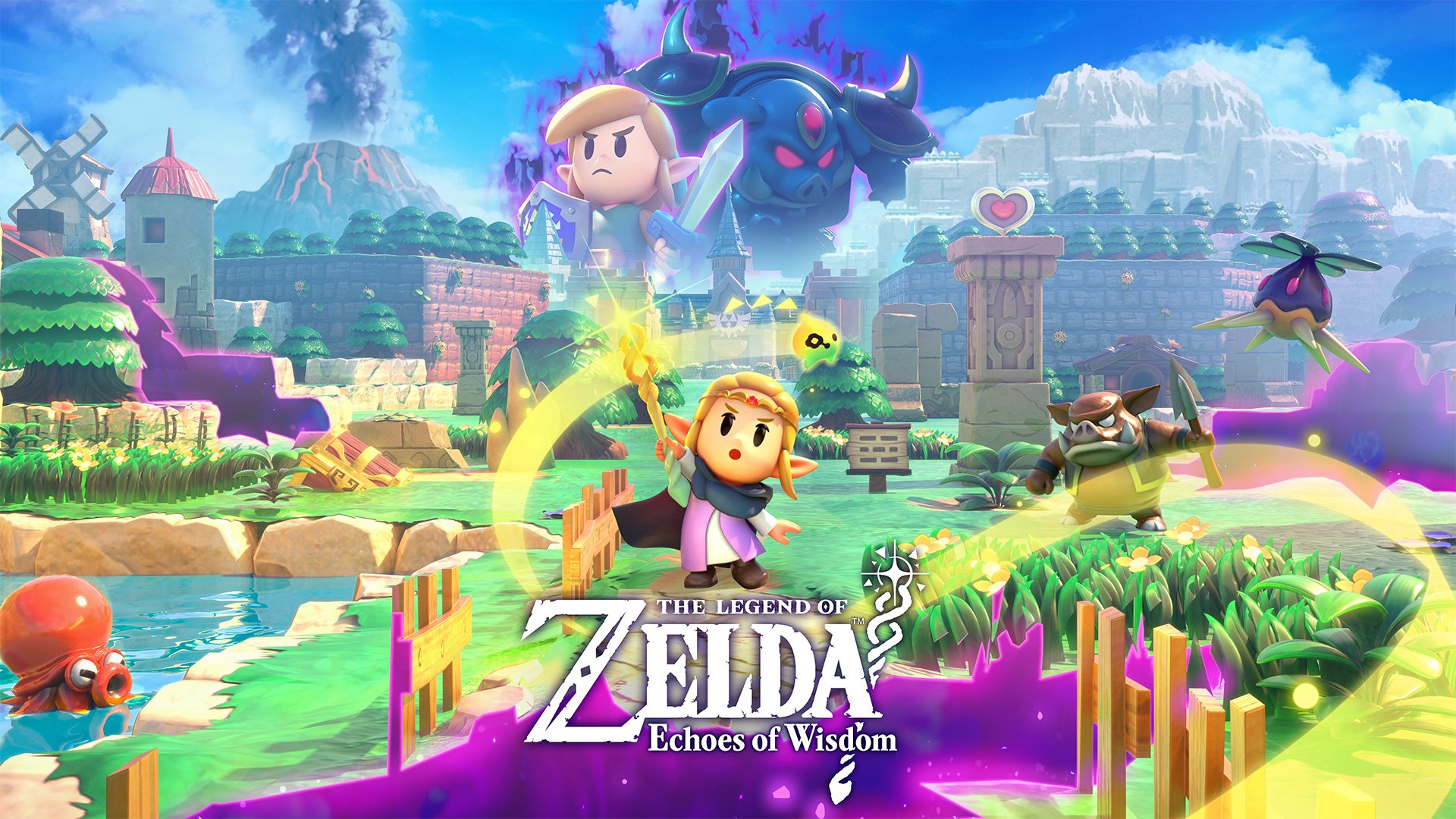
Today marks the one-year anniversary of The Legend of Zelda: Echoes of Wisdom. Released in 2024, this title masterfully merges the expansive freedom found in recent Zelda entries with the nostalgic charm of its classic top-down predecessors.
When Nintendo introduced The Legend of Zelda: Breath of the Wild in 2017, it completely reimagined the series. The traditional linear progression through dungeons was replaced by an immense, vibrant open world, inviting players to survive, explore, and uncover its secrets at their own pace. Six years later, Tears of the Kingdom further expanded upon this formula, adding vast floating islands above and mysterious subterranean caverns below Hyrule`s sprawling surface. Together, these two games set a new benchmark for open-ended adventure.
With The Legend of Zelda: Echoes of Wisdom, Nintendo, alongside long-time partner Grezzo, found a brilliant way to condense these explorative and freedom-oriented mechanics into a more contained experience. While Echoes of Wisdom may not rival the sheer geographical scale of its direct predecessors, it remarkably captures their core essence—player freedom—within its more intimate world.

At first glance, Echoes of Wisdom evokes memories of Grezzo`s acclaimed remake of The Legend of Zelda: Link’s Awakening. It employs a delightful, toy-like tilt-shift perspective, with the camera artfully hovering above a vivid, colorful overworld. Yet, beneath these inviting diorama-style visuals lies a design philosophy that deeply integrates the creative spirit of Breath of the Wild and Tears of the Kingdom.
In a groundbreaking move for a mainline entry, Princess Zelda takes center stage as the protagonist. She wields the mystical Echo Rod, a unique tool that grants her the ability to capture the properties of various objects and creatures and then reproduce them at will. Imagine copying a large rock and then spawning multiple copies to construct an impromptu bridge across a chasm, or even capturing an enemy and unleashing its echo to fight as your ally.
This innovative mechanic isn`t merely a substitute for the weapon durability or crafting systems seen in the Switch epics; it cleverly reimagines their sandbox approach on a more focused canvas. Where Link might fuse weapons or combine objects to overcome challenges in Tears of the Kingdom, Zelda collects and redeploys echoes to achieve similar feats of creative problem-solving. The result is a game that actively encourages players to invent unique solutions within its beautifully crafted top-down world, rather than simply following a single, predetermined path laid out by the developers.
Series producer Eiji Aonuma articulated this philosophy in an interview, stating, “Having worked on games in the Legend of Zelda series over the years, we started to feel that fans may not continue playing this franchise unless they can think independently and try various things freely on their own, rather than following a set path. Even when it comes to solving puzzles—in a game in the Legend of Zelda series, having the excitement of solving puzzles in your own unique way makes the game `Legend of Zelda-like.` Hence, we need to increase the degree of freedom to achieve that. With this in mind, I asked Grezzo to use those two elements as a foundation for the gameplay and add freedom on top of it.”
Aonuma`s words perfectly encapsulate the ambition behind Echoes of Wisdom: to preserve the exhilarating sense of experimentation that made Breath of the Wild a global phenomenon, but without necessitating sprawling continents or hundreds of hours of content. This focused approach received widespread praise upon the game`s launch in 2024. Steven Petite, in his review, highlighted that Echoes of Wisdom`s “brilliantly integrated echoes system links two eras, proving that the freeform mechanics of the new age can coexist with the franchise`s classic formula.”
Dungeons, once rigid obstacle courses, are now transformed into flexible playgrounds where players are empowered to choose their own methods of progression. Need to traverse a wide chasm? Construct a bridge from conjured beds. Want to defeat a powerful boss without engaging in direct combat? Summon echoes of enemies to fight on your behalf while you maintain a safe distance. Each puzzle is less about uncovering the single correct answer and more about discovering your personal, inventive solution.
This emphasis on freedom also significantly enhances the game’s pacing. Echoes of Wisdom respects the player’s time, offering engaging, bite-sized challenges that can be completed in shorter sessions, all without diminishing the thrill of discovery. It’s an ideal fit for the versatile nature of the Nintendo Switch, encouraging players to jump in and out of the adventure while still feeling a profound sense of impact on the game world.
Zelda`s ascension to the role of protagonist further solidifies this theme of new possibilities. Without Link`s traditional sword-based combat, battles often become another intriguing puzzle to solve. The Echo Rod serves as a clever bridge between narrative and mechanics: Zelda is not a conventional warrior, but rather a brilliant scholar and strategist. Her strength lies in keen observation and ingenious thinking, qualities that inherently encourage players to approach challenges from a fresh perspective.
By compressing the ambitious ideas of its predecessors into a more contained framework, Echoes of Wisdom also brilliantly highlights what truly made Breath of the Wild and Tears of the Kingdom so revolutionary. Those games weren`t merely defined by their enormous scale; they were fundamentally about player agency. The freedom to climb a distant mountain simply because it caught your eye on the horizon, to craft a bizarre contraption to outsmart an enemy, or to stumble upon a hidden shrine or sky island purely out of curiosity. Grezzo’s game thoughtfully poses the question: Can these profound feelings of freedom and discovery genuinely exist without a Hyrule spanning dozens of square miles?
Echoes of Wisdom unequivocally answers this question, serving as compelling proof that true freedom is measured not in vastness, but in the abundance of options, and the delightful uncertainty of not knowing precisely how you will overcome the next obstacle. The game enthusiastically invites players to be inventive and experimental—qualities that elevated the Switch’s two massive Zelda adventures to modern classic status.
In distilling that groundbreaking formula into something more intimate, Nintendo and Grezzo have accomplished far more than creating a mere side story. They have powerfully demonstrated that the fundamental spirit of The Legend of Zelda—the profound wonder of exploring a world and bending it to your will—can thrive regardless of its scale. Whether players are fusing colossal mechanical contraptions in Tears of the Kingdom or meticulously spawning a chain of beds to reach a hidden treasure in Echoes of Wisdom, the underlying sensation remains consistently the same: freedom, pure and exhilarating, reverberating across the entirety of Hyrule.