

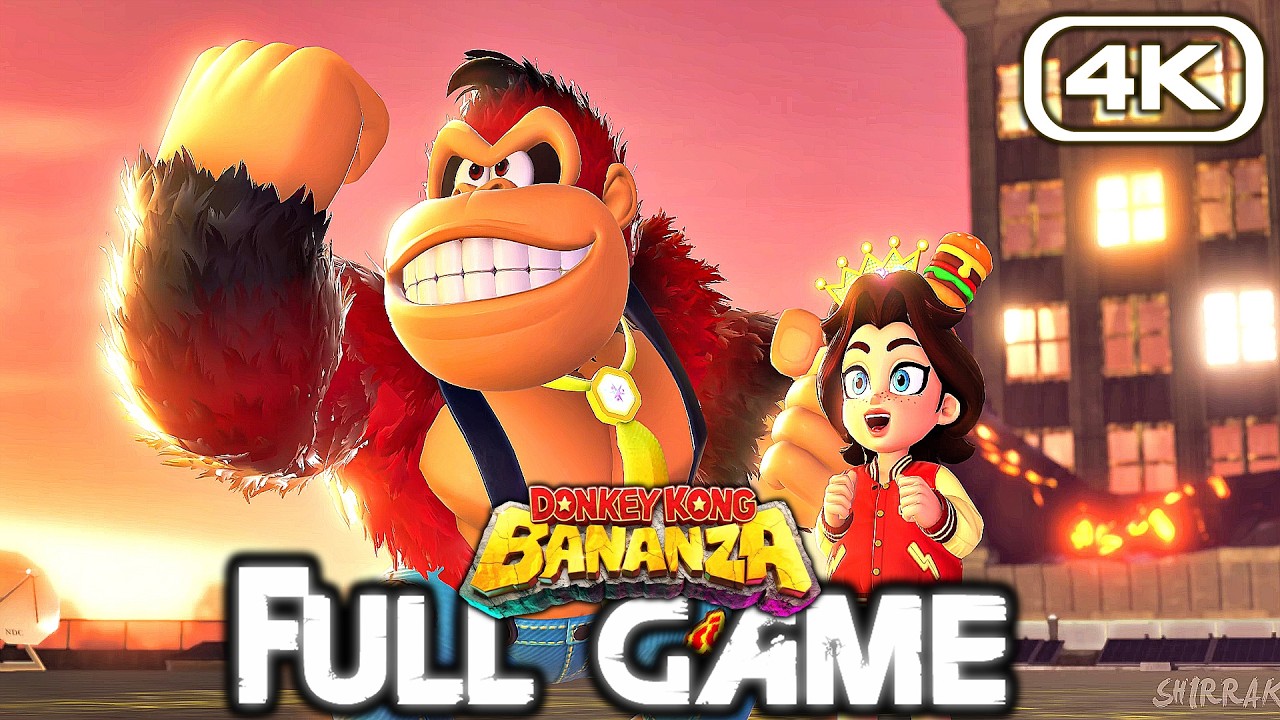
Players who completed Donkey Kong Bananza likely found it to be a relatively smooth experience, requiring minimal frustration or excessive effort. Many have noted that boss battles are quickly overcome, gold resources appear endless, and the game feels `too easy` overall. However, labeling it merely `too easy` oversimplifies the discussion, not only for Bananza but for game difficulty in general.
The perception of a game being `too easy` often carries negative connotations, suggesting it might be overly guided, failing to challenge players to strategize or think independently. It could also imply a dull and repetitive experience, devoid of deep mechanics, thus offering little reward for overcoming its challenges.
To dismiss Donkey Kong Bananza simply as `too easy` overlooks its fundamental design strengths and what truly makes it enjoyable. The game feels effortless because its underlying structure is sophisticated and adaptable, yet incredibly user-friendly and intuitive. Nintendo crafted Bananza to make players feel powerful, providing all the necessary abilities to navigate its expansive world with ease. If players perceive it as easy, it`s a direct result of Nintendo`s successful design intent: to create a fluid and empowering experience.
For most players, Donkey Kong Bananza isn`t their introduction to gaming; they likely possess a solid understanding of video game conventions. Nintendo designed Bananza with a clear “game language” that players can quickly master. As gameplay progresses, players intuitively combine basic controls to perform intricate maneuvers. This is somewhat reminiscent of Mario`s use of Cappy for platforming in Super Mario Odyssey, though Donkey Kong boasts an even broader range of abilities.

Donkey Kong Bananza encourages innovative problem-solving, effectively equipping players with its unique gameplay “language” so they can swiftly devise solutions. Frequently, the path to overcoming an obstacle is evident, but the game avoids overt guidance (despite the presence of arrow-shaped “Fractones” in key story segments). Players are instead prompted to draw upon their accumulated experience, recalling past challenges and the varied applications of their abilities to formulate a resolution.
My experience with Bananza frequently brought to mind The Legend of Zelda: Breath of the Wild (and its successor), given that both games allow for multiple solutions to problems, some of which might even feel like unintended exploits. Players develop an intuitive understanding of the game`s physics and environmental interactions, and both Bananza and Breath of the Wild offer ample freedom to experiment and tackle puzzles creatively. The challenge rooms in Bananza and the shrines in Zelda perfectly exemplify this, testing players` mastery of the game`s mechanics and their ability to apply them in diverse situations.
Both the open-world Zelda titles and Bananza equip players with such a wide array of skills and movements that devising personal, unconventional solutions can almost feel like exploiting the system. Consider moments in Bananza where you perceived a specific route for a Banandium Gem, only to forge your own quick path; or instances where you bypassed significant portions of a platforming challenge by simply gliding as an ostrich.
This doesn`t imply the game is flawed; rather, it highlights your cleverness in finding such approaches. Given the extensive testing modern video games undergo, Nintendo surely anticipated these player-driven solutions. Bananza`s design intentionally fosters the feeling that these ingenious workarounds are entirely your own discovery.

Despite this defense against the `too easy` label, it`s not meant to absolve Donkey Kong Bananza of all its shortcomings or shield it from legitimate critique. The boss battles, for example, are often forgettable and disrupt the game`s flow, while the plentiful gold supply fundamentally undermines its in-game economy. These imbalances in Bananza certainly merit discussion. However, dismissing the game outright as `too easy` detracts from the sense of accomplishment and empowerment it is designed to evoke in players.
While it might seem unusual to compare Donkey Kong Bananza with titles like Dark Souls or Elden Ring—games often perceived as `too hard` by some—the comparison holds merit. From Software`s “Souls” series, under Hidetaka Miyazaki`s direction, openly embraces its challenging nature. Yet, both Nintendo and From Software ultimately share a common design philosophy: to instill a profound sense of power in the player.
In a 2009 interview with Game Informer, Miyazaki clarified that difficulty was never the primary objective for Demon`s Souls. Instead, From Software aimed for players to experience an “intense sense of accomplishment” by developing strategies, conquering challenges, and making new discoveries. While the “Souls” series achieves this through its notoriously unforgiving gameplay, it shares with Nintendo titles the core principle of equipping players with the means to achieve that feeling of success.

Although games like Dark Souls are undeniably less accessible and more intricate than Donkey Kong Bananza, they are still fundamentally crafted to be conquerable. Video games should ideally empower players, fostering feelings of success, strength, and intelligence, a goal perfectly achieved by Nintendo`s design in Bananza.
Moreover, consistent with many contemporary Nintendo platformers, Bananza offers post-game content for those desiring a greater challenge. The Bananza Rehearsal levels, in particular, are known for their potential to be incredibly frustrating. For players seeking more intensity than the main game provides, these levels deliver, and successfully completing them brings a strong sense of satisfaction, or at least immense relief.
It`s unlikely we`ll ever cease using “easy” and “hard” to characterize video games; these terms are simply too convenient. Nevertheless, given the profound sense of empowerment these games can evoke, a more nuanced critical discussion is warranted concerning what genuinely makes a game feel easy or difficult, rather than condensing the entire experience into a solitary descriptor.
While I grasp why players might label Donkey Kong Bananza as “too easy,” we ought to commend developers for creating such an accessible experience. Beyond that, we should also recognize and appreciate our own proficiency as video game players.