

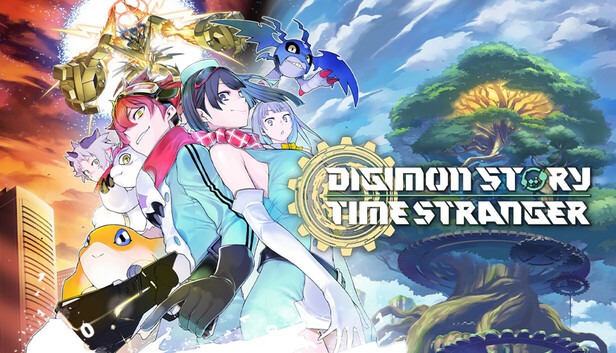
Digimon`s enduring appeal often stems from its ability to evoke nostalgia, a quality prominently featured in Digimon Story: Time Stranger. This seventh entry in the franchise`s role-playing game series continues the tradition of emphasizing narrative. However, during my three-hour preview session, it was the enthralling creature collection and sophisticated turn-based battles that truly captivated me, making me wish to continue playing long after the demo concluded.
Breaking from the norm of child or teen protagonists, Time Stranger places players in the role of an adult secret agent investigating mysterious Digimon-related incidents. My playthrough commenced at the very beginning of the story, revealing the Digital World`s pervasive influence on Earth. Players can choose their protagonist`s gender, with the unselected character becoming a partner who communicates through a compact hologram device. The opening brilliantly establishes a world where two realities collide, showcasing ordinary citizens discussing bizarre disasters and protestors accusing authorities of concealing secrets.

While the compelling backdrop is significant, the core gameplay is where the game truly shines. The Digimon Story sub-series is renowned for its story-driven foundation, typically enhanced by turn-based combat. Producer Ryosuke Hara, known for his work on Dragon Ball Z: Kakarot, highlighted “battle balance” as a crucial area of focus. Being 36 years old, Hara was part of the target audience when Digimon Adventure first launched in 1999, bringing a seasoned perspective to the development.
“There are a few things that we wanted to improve on from the past installments of Digimon`s Story, but one thing [in particular] was the battle balance,” Hara communicated via a translator during my session. “I think in the past versions, people were relying on certain characters way more than their being balanced. So for this title, we wanted to really improve on the RPG battle aspect of the battles.”
Time Stranger introduces its core “type triangle” mechanics early on, akin to the elemental system in Pokémon or weapon triangles in Fire Emblem. This functions similarly to previous Digimon Story titles like Cybersleuth, where a Digimon`s main classification heavily dictates its strengths and weaknesses, even alongside secondary elemental vulnerabilities. To illustrate this, the game offers a choice of initial Digimon, each representing a different type: Patamon (Data), Gomamon (Vaccine), or Deviveemon (Virus).
I opted for Patamon, a favorite partner Digimon from my childhood memories of Digimon Adventure. Patamon effortlessly handled most enemies in the first 30 minutes, but soon I needed to strategically employ other Digimon, such as Koromon, to leverage type advantages. With approximately 450 Digimon integrated into the game, a vast number of creatures beloved by older fans from the shows and games are represented.

Within the initial two hours, nearly every Digimon I encountered, from obscure digital monsters briefly featured in Digimon Adventure to popular characters like Agumon, was recognizable. While Time Stranger clearly targets older fans who grew up with Digimon Adventure, it tells a completely new story, ensuring that newcomers can dive in without any prior knowledge of the franchise`s past.
When questioned about what sets Digimon apart from other monster-taming series, Hara emphasized its distinctive evolution system. “Digimon`s evolution system is not the same as other people`s,” he explained. “If you were to take Agumon as an example, Agumon digivolves into multiple different forms. And then from there, again, multiple different forms. If we were to compare one player to another player, how they evolve their Digimon is going to be very different from another player.”
This dynamic evolution system is, for me, the most compelling aspect of Time Stranger: the joy of collecting Digimon. Digivolutions in this game operate differently from their Pokémon counterparts, where most Pokémon have fixed, linear evolutionary paths. In Digimon, a “baby” Digimon like Koromon can potentially digivolve into Agumon, Guilmon, Dracomon, and various other forms. The specific evolutionary outcome often remains a mystery until the Digimon digivolves, revealing how your nurturing has influenced its transformation.

Players can capture multiple instances of a Digimon or even de-digivolve their current ones to explore alternative evolution paths. For instance, I de-digivolved my Pagumon because I found its appearance less appealing. However, be aware that de-digivolving reverts the Digimon to Level 1 in its baby form, presenting a new challenge if you act on impulse.
Adding further depth, Digimon now possess one of 16 distinct personalities, each with unique “matrices.” These matrices allow players to influence a Digimon`s stats and learned abilities based on how they are raised. For example, enhancing a Digimon’s Valor can boost its HP and attack growth, while specific Personality Skills can strengthen attacks or reduce skill point consumption.
An endearing new feature is that your Digimon actively communicate with you. Your core team, consisting of up to three Digimon, follows you and asks questions as they level up—ranging from inquiries about friendship to suggestions for their next special move. This adds a charming layer to the gameplay and offers practical benefits, as your responses can subtly affect their stat progression and, consequently, their digivolution, given that some evolutions have specific HP or INT stat requirements.
During my preview, the engaging battles and creature collection largely took precedence over the narrative, which is understandable given the limited story progression and the short time to bond with characters. I am optimistic that the characters and story will prove as compelling as the Digimon themselves. Even without that guarantee, the sheer variety of ways to raise and evolve my Digimon would be enough to draw me back into the game.
Time Stranger arrives at a point when the Digimon series has been relatively stagnant, often relying on the fond memories of Digimon Adventure rather than exploring new territory. However, as the first Digimon Story game in a decade, and with what appears to be the most comprehensive battle system the series has seen yet, my anticipation to revisit the Digital World is at its peak in years.
Digimon Story: Time Stranger is set to launch on October 3, 2025. For those who can`t wait, a recommended playthrough of Digimon Story: Cybersleuth (and its follow-up, Hacker`s Memory) offers a great way to understand the foundational elements leading into this new title.