

Please be aware: this article contains spoilers for Final Fantasy VII Remake, Final Fantasy VII Rebirth, and Final Fantasy IX.
The recent surge of rumors concerning a Final Fantasy IX remake evokes a degree of apprehension. A primary reason for this unease is that Square Enix has already provided a modern remaster of the original game, ensuring its perfect preservation for existing fans and accessibility for newcomers. However, an even more significant concern arises from Square Enix`s approach to the Final Fantasy VII Remake trilogy and the broader industry`s perspective on remakes.
The subject of video game preservation is currently a prominent discussion within the gaming community. Data from the Video Game History Foundation indicates that roughly 87% of all games released before 2010 are now `critically endangered,` implying that only about 13% remain easily playable. This signifies a substantial number of games facing the threat of permanent loss.
Nevertheless, this doesn`t mean that companies are entirely neglecting efforts to preserve their popular titles. In recent years, Capcom has successfully re-released and remastered beloved entries from series such as Resident Evil, Ace Attorney, and Mega Man. Konami has also satisfied fans with a highly anticipated Metal Gear collection, and Square Enix itself has provided numerous excellent remasters across its Kingdom Hearts and Final Fantasy series.
Alternatively, many companies are opting for the `remake` approach when revisiting classic titles. This strategy involves rebuilding games to update their controls, graphics, or even narrative elements for contemporary players. Prominent examples include the remakes of Resident Evil 2, Silent Hill 2, Demon`s Souls, and Dead Space. Given the original versions of these games are celebrated as timeless masterpieces, it`s understandable that studios might prefer to reinterpret them rather than simply emulate existing designs. However, while these comprehensive overhauls are frequently acclaimed, some core aspects that defined the originals can occasionally be lost. This phenomenon is particularly evident in Square Enix`s Final Fantasy VII Remake trilogy, which deviates from a simple update to instead completely reimagine the original game, merely using it as a foundational concept.
Therefore, the idea of Square Enix undertaking a complete ground-up remake of Final Fantasy IX, as opposed to preserving its original vision, is a source of considerable hesitation for me.

The announcement of the Final Fantasy VII Remake was met with a mix of excitement and uncertainty. Questions arose: would it retain its turn-based combat? Would it faithfully follow the original narrative? Would it be a standalone title? The answers eventually came in the form of an ongoing trilogy featuring real-time action combat and substantial alterations to key plot points, effectively transforming Final Fantasy VII Remake into a narrative continuation of the original. Regardless of one`s perspective, the new Final Fantasy VII experience is distinct and not a direct substitute for its predecessor.
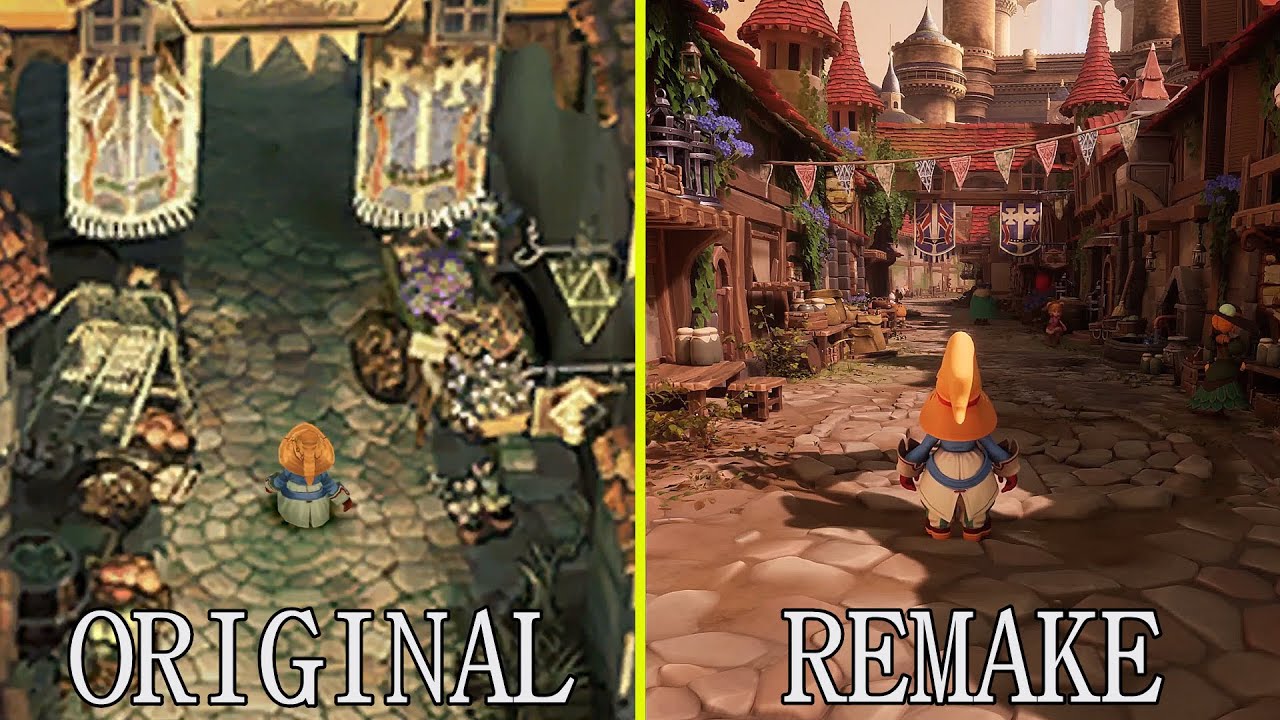
This naturally prompts speculation about a potential Final Fantasy IX remake. Given that a modern remaster already exists, it`s plausible that Square Enix`s remake ambitions for FFIX would mirror those for FFVII Remake, suggesting a more radical reinterpretation. Will this new version compromise the original`s unique charm and distinctive qualities to appeal to contemporary tastes? Final Fantasy IX is renowned for its homage to earlier Final Fantasy titles, a characteristic evident in its art style and gameplay. Its world, Gaia, is brought to life by some of the series` most beautiful pre-rendered backgrounds, resembling storybook illustrations and significantly enhancing its fantastical atmosphere. I can`t help but question if a shift to fully 3D environments in a remake would diminish this intrinsic charm.
Furthermore, I`m concerned that a Final Fantasy IX remake might introduce narrative alterations, similar to those seen in the FFVII Remake. Iconic moments, such as the revelations concerning Mog or Vivi, could be rewritten or lose their profound impact. Final Fantasy IX is often lauded as a high point in the series` storytelling, and a complete remake risks introducing creative liberties that fundamentally change the narrative experience. A prime example is the handling of Aerith`s death in Final Fantasy VII; an unforgettable scene depicting Sephiroth impaling the beloved character with his Masamune. In Final Fantasy VII Rebirth, this pivotal moment is diluted through a series of ambiguous visions, dream sequences, and temporal shifts, rendering it unrecognizable, confusing, and significantly less potent.
Could Square Enix abandon the classic Active Time Battle (ATB) system, a hallmark of traditional Final Fantasy games including FFIX, in favor of a more action-oriented combat style to appeal to players of Final Fantasy XVI or Final Fantasy VII Remake? The ATB system promoted strategic decision-making with each turn. In contrast, Final Fantasy VII Remake often allows players to simply spam attack commands in many encounters, reserving abilities primarily for later-game and boss battles. While FFVII`s transition to real-time action feels somewhat appropriate given its futuristic backdrop, FFIX`s fantasy setting and core identity are deeply intertwined with its traditional ATB system. Such gameplay alterations might extend to pivotal scenes like the sword fighting tournament, potentially simplifying it into a quick-time event, much like the Shinra parade sequence in Final Fantasy VII Rebirth.

While Final Fantasy IX is widely acclaimed, it`s not without its imperfections; some concepts aren`t fully realized. For instance, the Trance system, FFIX`s equivalent to FFVII`s Limit Break, allows characters to enter powerful states after sustaining significant damage. Though not always mechanically flawless, Trance effectively communicates a character`s escalating fury and determination to survive, enhancing the game`s distinct charm. Removing it would be akin to eliminating the codec calls from Metal Gear Solid games for the sake of simplification, thereby stripping away a core part of their identity – a simplification that, notably, did occur in later Metal Gear entries.
Zidane, the protagonist, represents another element susceptible to change. Despite his widespread appeal, he exhibits some questionable character traits, notably his womanizing and excessively flirtatious conduct toward Garnet. Yet, these very flaws are integral to the significance of his journey, character development, and eventual growth, rendering his apparent demise and triumphant return to Garnet one of the series` most touching moments. An excessive attempt to `modernize` his personality for a more positive portrayal could diminish the impact of his arc and alter the audience`s perception of the game`s powerful conclusion.
Could it be that my concerns are unwarranted, and an FFIX remake might successfully navigate the challenges encountered by the FFVII Remake trilogy, preserving the original`s charm flawlessly? Perhaps. Does the emergence of a reinterpreted Final Fantasy IX invalidate the original? Certainly not. However, if this new iteration is promoted as the definitive way to experience the game, yet it fails to capture the essence that made the original so unique, doesn`t that signify a loss of its inherent magic?
It is crucial to be able to revisit and experience games in their unadulterated forms. Companies that diligently preserve and make classic titles accessible are moving in the right direction; Square Enix demonstrated this by releasing Final Fantasy IX on modern platforms. Yet, when companies opt to needlessly remake cherished titles solely for contemporary appeal, they jeopardize the public`s perception of these works, even if the original source material remains intact. Diluting distinct ideas and designs into a `one-size-fits-all` model, while retaining the name of a classic, inevitably leads to a loss of something fundamental. Final Fantasy IX stands as a masterpiece of narrative, gameplay, and artistic direction, potentially representing a pinnacle for the franchise. Should a remake indeed materialize, my hope is that Square Enix will diligently recall the elements that made it truly exceptional.